(Courtesy: Ratna Sansar Shrestha)
Latest Scenario
As far as the latest scenario is concerned, I am apprehensive that Nepal will have electricity crisis spanning next 10 years and further, if the relevant policies are not completely overhauled. NEA, during its anniversary celebrations, claimed that after five years, load shedding will be a matter of the history. This is not the full truth. The problem is as follows. NEA claims that another 806 MW will be generated in the next five years and there will be 1493 MW in total in the system and based on their own load forecast, the demand then will be 1271 MW (in peak season) which will lead one to jump to the conclusion that there will be surplus electricity. But in reality, 1493 MW will be the total installed capacity which can generate at full capacity only during the rainy season and it goes down to half to one third of the capacity during the dry/peak season, creating scarcity again due to short fall of 400/500 MW even if all the projects that NEA has in the pipeline are completed on time. There will be shortage of electricity in five years’ time by a higher magnitude if these projects are not completed in time, as is the general tendency.
Now that the government has set a target to generate 10,000 MW in 10 years’ time of which about 8200 MW is for export purposes and 1800 for domestic consumption, the total installed capacity for domestic consumption after 10 years will be around 2500 MW and load forecast for that year is 1900 MW; an apparent case of surplus generation. But again, there will be seasonal dearth of electricity due to the above-mentioned phenomenon. Even after addition of 10,000 MW capacity after ten years, load shedding will continue to exist. Therefore, the government needs to change its policy drastically and focus more on the hydropower development for the purposes of domestic consumption first.
In Nepal, the average electricity consumption per capita is 69 kWh per annum which in the developed countries it is around 20,000 kWh. Economy of a country is linked to the electricity consumption. Electricity can be used for industrialization, employment generation, agro processing, irrigation, cold storage, changing lifestyle and so forth. Even it can displace POL products for transportation by electrifying transportation, e.g. electric railways along east-west highway. By just undertaking Kathmandu-Birgunj railway Nepal can displace 120 thousand kiloliters of fossil fuel in a year. This can significantly reduce both trade deficit and balance of payment deficit of Nepal with India. The government is planning to construct fast track road linking Kathmandu to Terai instead of which it should have chosen electric railways in order to escape from the fossil fuel dependency syndrome.
The generation of 10,000 MW is possible only if the government can arrange to mobilize an investment of Rs 1,500 billion. It all depends on how effectively the government can lure the investors, which is not an impossible feat, though. Nepal is receiving Rs 150 billion annually from remittances from authorized sources which alone is sufficient for 1,000 MW. Therefore, 10,000 MW in 10 years can be generated from this source alone. But we don’t need to use remittance alone for the purpose; there are many domestic investors interested to invest in hydropower. Besides, there are foreign investors also interested in implementing hydropower projects. Having said this, 10,000 MW, therefore, is not beyond our reach. However, from infrastructural perspective, Nepal is not prepared for the implementation of this size of hydropower projects; we lack necessary infrastructure like access roads and transmission network. To some extent, these infrastructures will be developed by the investors as well but not all. Therefore, the government should also construct necessary infrastructures. Otherwise, the higher investment by the IPPs will be reflected in the bulk electricity tariff which ultimately affects the consumers making electricity unaffordable in this water resources rich country.
There are many people holding licenses for hydropower projects but they have not been able to implement due to lack of sufficient capital (some don’t even have fund to conduct feasibility studies). Generating one MW needs initial investment of about Rs 150 million. The government has been liberally giving away licenses to any applicant even to those without financial capability to mobilize necessary fund because of which power generation has been far less than the capacity of the licenses issued. This is a policy failure. On other hand, the NEA has been circumspect in signing PPAs which too has been creating constraint in the implementation of the power projects. Therefore, the government should ensure that the applicants have required capital before issuing licenses while NEA should sign PPAs liberally to solve the current constraint in power supply. Otherwise, the load shedding will grow year by year and will adversely impact our macro economy.
Reforms Required
Licenses should not be issued to those who are unable to mobilize necessary equity.
NEA should be liberal in signing PPAs but should implement penalty clauses against those who are unable to generate electricity in time or are more interested in peddling the PPAs.
Domestic consumption of electricity should be prioritized. The government should ensure that 100 percent of its population has access to the electricity which now is limited to 25 percent that too with load shedding. Also increase the per capita consumption of electricity which now is 69 kWh. The politicians talk about transforming Nepal into Switzerland which will be possible only by increasing per capita electricity consumption in Nepal, too. The per capita energy consumption in European countries is over 20,000 kWh. Therefore, the priority should be that in next ten years, the per capita electricity consumption will be 10,000 kWh in Nepal not that we generate 10,000 MW in ten years and export most of it and, thus forcing to continue load shedding in Nepal.
I am not averse to export of electricity but on certain conditions only. The government has the right to export its hydropower only after electrifying all Nepali households. Further the tariff of exporting and importing hydroelectricity should be comparable to each other. i am disappointed with the fact that West Seti Hydropower Project, a reservoir project, exports electricity to India at less that US 5 ¢ per kWh while NEA imports from India at US 10 ¢ per kWh. In the meantime, parts of Nepal are supplied with thermal electricity costing around US 40 ¢ per kWh. West Seti electricity should be primarily used for the development of Seti-Mahakali Region and only surplus electricity should be exported. The export policy should be such that we sell our surplus during rainy season (peak season in India) at reasonable/appropriate price.
The promised 60 MW to be provided to Nepal by India to counter power shortage during winter this year will cost NEA more than Rs 7 per unit (excluding other costs within Nepal) whereas NEA’s weighted average retail tariff is Rs 6.70 only. Therefore, these discrepancies should be resolved in the interest of the country.
The claim of government receiving revenue of Rs 250 billion by exporting 10,000 MW after 10 years is ridiculous. It will only amount to Rs 3 billion commensurate to royalty and tax rates, because the bulk of the amount will be spent in paying back the loan including interest and dividend to the investors, according to Shrestha. It is only about four to five percent that will accrue to Nepal by exporting hydropower. Many assumptions of these people are not grounded to the reality.
It is not necessary that reservoir projects cost more than normal hydropower projects. Large hydropower projects, though reservoir based, cost less than small HP plants due to scale economy. Average cost of construction comes around Rs 150 million per MW. One of the costs that is not included is the inundation or submergence. West Seti HP project inundates 3000 hectares of land including existing infrastructure, forest, wildlife etc which Nepal loses for ever but this cost is not internalized in the cost of the project which is about one billion dollars. West Seti reservoir augments the flow by 90 cubic meters per second of water during dry season which can generate Rs five billion per annum for Nepal based on the Lesotho precedent who charges South Africa $ 25 million per annum for 18 cubic meter per second. But Nepal is going to provide the augmented flow to India free of cost. As West Seti reservoir project is in the north of the Terai districts like Kailali, Kanchanpur, Banke, Bardiya, it should either be developed as a multipurpose project which can irrigate the land in these districts or India should be charged for the augmented flow.
Under Koshi Treaty the embankment was built on both sides of the river, which was breached by Koshi River due to criminal negligence in failing to conduct regular repairs and maintenance of it. With the water from the barrage, less than 7 MW power is generated in Kataiya, India. Because of the embankment breach, Nepal incurred a loss of about Rs 10 billion due to the loss of land, loss of settlement, wild life, industrial production, damage to infrastructure etc. but the loss in terms of electricity is not that substantial due to its small size. Some transmission towers were uprooted because of which Nepal cannot evacuate power from India. Until the diverted river comes back to its original course, neither the hydropower could be operated nor electricity can be imported through that part from where the NEA is said to import 40 MW of electricity until completion of its renovation.
What has been the contribution of Small HP projects?
Small HP projects developed by private sector have made substantial contribution. NEA has been building projects at the average cost of more than 3000 dollars per kW whereas private sector has been developing at less than 2500 dollars per kW. Middle Marshyangdi outrageously costs 6000 dollars per kW. Small HP projects are showing how economically can they be built compared to the big projects which are supposed to cost less due to scale economy. Another worthy effort of the private sectors is that they are able to complete their projects on time but NEA’s projects are always delayed. Even the highly acclaimed Chilime HP was delayed by five years.
Wednesday, January 21, 2009


Thursday, January 15, 2009
Better Late than Never!
(Courtesy: el Guapo)
The last month and a half in Nepali politics has witnessed a silent revolution of sorts. No, it’s not the Maoists’ who are at the helm of this quiet revolution. Rather, it is the Nepali Congress that has finally begun playing the role of a credible opposition party by checking Maoist aggression on issues related to the Nepali Army, religion and land ownership.
On the Nepali Army
Through Koirala’s Machiavellian style of leadership, the Nepali Congress has begun to simultaneously chip away at each of the Maoists’ Achilles’ heels. First, the pivotal role that the Nepali Congress played on the issue of recruitment for the Nepali Army was commendable.
The NC’s rise to the defense of a national institution that has demonstrated its professionalism and commitment to democracy time and again, has placed the Nepali Congress is a completely different limelight. The outpouring of support on the Army’s position on recruitment sounded more like the type of rhetoric that would come from a national government than from an opposition party.
Although the sudden burst in support for the Nepali Army most certainly had its own brand of political motivation, the NC’s demand to maintain the political independence of the Nepali State’s tier-one security asset was well-timed and immaculately executed.
The message that the NC delivered was flawless - that the Nepali Army should not be dragged into political controversy, should be permitted to fill its vacant spots and that the pursuit of both of these tasks is in the national interest and not in contravention (in either letter or spirit) of the Comprehensive Peace Agreement.
By adopting this line, the Nepali Congress demonstrated its capacity to learn from past mistakes, its ability to adapt to Nepal’s changed political context and more importantly, its ability to contain Maoist ambitions in a very logical and disarming manner.
By insisting that the Nepali Army be permitted to carry on with filling its vacant positions, the Nepali Congress also managed to weaken another pillar of unyielding Maoist support - Mr. Ian Martin, who at the time of this writing, is rumored to be in the process of being “diplomatically” replaced.
On Religion
The controversy over whether Indian or Nepali priests should conduct ritual prayers at the most significant Hindu temple in the world (Pashupatinath) was dumb luck for the Nepali Congress and truly a dumb calculation on the part of the Maoists’.
By forcibly intruding on a matter of religious significance, the Maoists’ literally shot themselves in the foot. A blatant violation of the tenet of maintaining separation between religion and the state occurred and the Nepali Congress was at the right place at the right time to capitalize on this Maoist blunder.
As the saying goes, one must make hay while the sun shines and this was exactly what the Nepali Congress did. As soon as the news of YCL (Maoist) cadre physically assaulting Hindu priests hit the airwaves, the Nepali Congress was at the forefront demanding a reversal of the Maoist government’s decree to discontinue the tradition of Indian priests performing religions rites at Pashupatinath.
The NC’s stance immediately curried Indian favor, especially from within the ranks of India’s powerful Hindu-aligned BJP party, and also from Nepal’s religious Right. The memory of Nepal’s top Hindu activist having been murdered by the Maoists’ emerged to the top of the rhetorical agenda and on a second issue in succession, the Maoists’ were forced to concede their original position.
Once again, most peculiarly, the Nepali Congress demonstrated the qualities of a ruling party while playing the role of an opposition force. If only some semblance of such high thinking had characterized some of their rhetoric when the NC was actually in power (at any point in the post-1990 period), it would be the NC and not the Maoists’ who would be riding at Nepal’s helm today.
On Property Rights
Although the issue of land reformation is a complicated one, the NC’s insistence that the Maoists’ return stolen property to their rightful owners, is brilliant. The logic forwarded (and rightly so) by the Nepali Congress is that the return of property is a priority that the Maoists’ agreed to on paper, as part of the Comprehensive Peace Agreement and multiple successive agreements thereafter. The Maoists’ have failed to deliver.
So when the Maoists’ complain that the NC is not allowing the peace process to reach its logical conclusion by stone walling the Maoist combatant issue, the NC’s response is that while important, the Maoist combatant issue isn’t the only item on the peace agenda. To this, neither the Maoists’ nor Ian Martin, nor any foreign government sympathetic to the Maoist cause has a logical response and the NC knows this.
The manner in which the NC has framed this debate is that legal procedures and not forced acquisition should guide the process of land reform. Many of the landowners who have been disenfranchised by the Maoists, belong to the ranks of the Nepali Congress. But political activists have rights too and there is no constitutional exception when it comes to the State’s responsibility to protect the rights of its citizens. It is unfortunate for the Maoists that in this particular case, it is they who are the perpetrators of the crime and soon to be the prosecutors of the “criminals” as well.
Conclusion
The Maoists’ had initially gauged Girija Koirala’s lust for power aptly. By luring Koirala with the dream of becoming Nepal’s first President, the Maoists’ gained one concession after another from the SPA (Seven Party Alliance). They used Krishna Prasad Sitoula and Shekhar Koirala to forward the Maoist agenda and in doing so, managed to keep the international community at bay. The Maoists’ used the UNMIN (UN Mission in Nepal) to consolidate their credibility, opted for elections once they were certain to deliver a stunning victory and finally ascended the apex of Nepal’s power pyramid.
Now the dream is over and it is increasingly apparent that all of the Maoists’ tactical calculations have been on target with the exception of one. The Maoists’ appear to have grossly underestimated Koirala’s single, yet prescient talent - his tired and true subject matter expertise in bringing down governments and political opponents, with finesse and unassuming candor.
Girija Prasad Koirala may fail every test known to man in good governance; he may be clueless in the art of management; he is certainly a stranger to the idea of succession planning and intra-party democracy. But when it comes to undermining and humiliating his political opponents, Girija Koirala is a one man army; a global authority whose services would benefit any effort at toppling governments and breaking up coalitions, anywhere in the world.
It is under Girija Prasad Koirala’s leadership that the Nepali Congress is finally showing some mettle. And given all the totalitarian hints the Maoists keep dropping, the dismal state of lawlessness, and an economy of the verge of collapse, the time is coming once more for the Nepali people to choose between the lesser evil - Girija Koirala with his demonstrated deficiencies in constructive leadership or Pushpa Kamal Dahal with his demonstrated proficiencies in orchestrating cold-blooded mass murder.
Tuesday, January 13, 2009
Unite for Democracy
(Courtesy: Dr. Hari Bansha Dulal)
Radical communists regard goodwill gestures and concessions as nothing more than contemptible weakness and an irresistible invitation to take advantage.
The Maoist ascendency to the power was the biggest political surprise of 2008. The result of the Constituent Assembly (CA) poll, which was conducted without the required political preparation and adequate security arrangements by the Nepali Congress (NC) led government, shocked everyone: from immediate neighbors to the power centers overseas. As a matter of fact, the "April surprise" not only shocked the keen observers outside the country, but also the major political parties of the yesteryears, who till then thought that they were the ones that were actually mainstreaming the Maoists.
The CA election completely turned the table around. All of a sudden, benevolent appeasers, whose never ending concessions to the Maoists reduced a genuine peace process to an "appease process" were at the receiving end. An unexpected victory in the CA election gave the Maoists an opportunity to go their own way.
While the people who are aware of what radical communism is capable of delivering watched the Maoist ascendancy to the power with trepidation, gullible "coffee shop" hopping intelligentsia appeared least bothered. The defeat of democratic forces in the CA election was rationalized as a step forward in integration of the Maoists into the democratic process. The Maoists know very well as and how to garner the sympathy and support of a gullible intelligentsia and partisan civil society, don't they?
It's been almost nine months since the CA election was conducted and approximately four months since the Maoists formed the government. A question that we ought to be asking ourselves is -- are we in fact better off than we were a year ago? If the answer is no, how long should we wait before we decide to do something about the rapidly worsening situation?
Puspa Kamal Dahal, himself, has admitted that he has failed to deliver and match the people's expectations. The grand dream of transforming the nation with hydro dollars has gone bust after the declaration of energy crisis. Hundred plus hours of load-shedding per week and labor union militancy have dwarfed the possibility of foreign direct investment in the country. How will the Maoists transform the nation and provide dividends they have been promising all along? Every Nepali should be asking this question in order to come to a rational conclusion on whether or not the Maoists have what it takes to transform the nation.
The Maoists simply do not care about the sufferings of poor and the downtrodden. They gain from the unfair advantage that Nepalese people suffer from a lack of hope in the possibility of getting an authentic and good government that will tend to the grossly unattended needs of our society. What the Maoists are doing is cleverly manipulating the psychological insecurities of Nepali people. They are least concerned about how badly it hurts collective self-esteem.
Instead of taking responsibility for the failures, Puspa Kamal Dahal and his psy-war experts, are once again threatening a "mass revolt." They do so because it benefits them politically. By simply reminding of us pain, suffering and dread of future terror, they want us to eventually weaken and give in to their demands. Their ultimate goal is to capture our hearts and minds -- to convert us.
How can threat of bloodshed transform our attitudes in favor of the Maoists' worldview? Wouldn't we recoil in horror and, if anything, move farther away from sympathy toward the perpetrators of violence? Nope. Look at how jihadists in radicalized Islamic societies across the world "convert" innocent individuals to Islam by threat of death. It is just a matter of applying the tactics that works at individual level to a larger scale. It does work. The counterintuitive result of the CA election is a proof. It's been already tested on our own soil.
When Thomas Jefferson said that "people get the government they deserve," he must have had people like us in mind, who can easily be duped. It did not take us very long to buy "revolutionary dreams" sold by the Maoists, did it?
So what is the way out? A strong democratic alliance is the need of the hour. It, however, has to have clear goals and objectives. Or else, it will be perceived as a "grand design" of fat cats within the NC, UML, RJP, and RPP to make a grand come back, and hence, will not take off. The Nepali people, who have been duped again and again in the name of salvation, deserve a detailed plan about how salvation would occur this time around. There are way too many "dream merchants" in Nepal for people to believe in.
Patience is great, but the longer we wait, the more damage gets done. The very day our southern neighbor comes to a conclusion that the China-leaning Maoist regime cannot be dislodged anytime soon, disintegration of Nepal is guaranteed. For India, its national security is more important than territorial integrity or sovereignty of Nepal.
The delay in emergence of a strong democratic alliance will cost us dearly. The Maoist party by cozying with Upendra Yadav is under a false impression that Madhesi revolt is all but over. Besides that, the Maoists do not have any moral ground to go against the wishes of the ethnic parties since they ignited the flame of dissident politics. It has to be done by an outfit that understands the threat and is genuinely interested in empowering the Madhesis. By not going after a permanent solution, the Maoists are allowing ethnic hustlers that are ready to outdo Lengdup Dorje to forward their political agenda.
By attacking media and interfering in religious tradition, the Maoists are feeling the pulse of Nepalese society. They will tell you what you want to hear, but will do what benefits them politically. The Maoist ministers' sojourn to the jail where Ramesh Babu Pant and Ramesh KC were housed clearly exhibits moral bankruptcy on part the Maoist ideologues. Don't we know already how low they can stoop?
There might still be some within the major political parties of yesteryears that think "appeasement" is the only way out to moderate the Maoists and secure the lost political space. This is a prescription for disaster. Appeasement always encourages your master to further subjugate you. If more subjugation is not immediately forthcoming in response to appeasement, it's only a strategic delay. Radical communists regard goodwill gestures and concessions as nothing more than contemptible weakness and an irresistible invitation to take advantage.
Ignore history at your own peril!
Monday, January 12, 2009
Socialism and Communism Sans Austerity
(Courtesy: Shyam Prasad Adhikari)
"The last stage of socialism is communism" is what a political thinker has said. As stated by Karl Marx, "Communist society is one where each individual works according to his/her's capacity and in return takes from the society all that he or she requires." The major difference between socialist and communist system is that under the socialist system the individual gets from the society all the material benefits in proportion to his or her capacity, whereas under the communist system, because of abundance of goods and services, capabilities loose their significance enabling each member of the society to get all the benefits that an individual requires.
Nepal has been declared a republic and the present government is led by Communist Party of Nepal-Maoist. For any new government coming to power in Nepal, it has become a customary to issue directive for the maintenance of austerity measures to check public expenditures. But unfortunately, the directive remains in paper only, and is taken as a ritual by ministers and all government functionaries. As a result, no one feels responsible and accountable for monitoring and implementing it. The present government too, seems, performing the same ritual by issuing the austerity directive through the cabinet, recently. But the sad part of the story is; "Even as the government has approved a special directive through the cabinet, vowing to check unnecessary expenditures, one-third of the ministers of the current cabinet have left the country on foreign jaunts putting great pressure on public exchequer".
The country is, currently, undergoing difficult political situations and is weighted down by myriad socio-economic problems. People, in general, have started commenting on the ministers' expensive foreign tours by calling the austerity directive of the government as a "Pennywise and pound foolish" decision.
We have now a communist-led government, which believes in communism. Socialism and communism imply national ownership of the means of production and distribution. The idea of fair distribution of goods and services and also of austerity and equality are inherent in these concepts. But a highly tragic aspect of our political leaders versions of socialism and communism are that those who loudly profess them, themselves make a mockery of it by living in grand, ostentatious style and regarding themselves as a privileged class even while countless millions of Nepalis do not get a square meal and go semi-naked. Despite the periodic exhortations by exponents of socialism and communism asking people to economies all-round, in view of the unprecedented economic crisis, foreign cars and Prado jeeps are still being bought from the foreign companies for the use of ministers, MPs and bureaucrats. The cost of ministerial comfort to the public exchequer is indeed very heavy. Their salaries represent a fraction of what the nation has to spend on them and on all the pomp and show that are deemed essential whenever prime minister and ministers go on foreign tours or visit districts to inaugurate a function. Their prerequisites are so many and so out of tune with the times, that many foreign visitors wonder at the governmental extravagance, while the country is still associated with the begging bowl at international forums and in affluent countries.
The conduct of Heads of state and ministers in capitalist or non-socialist countries provides a sharp contrast. The Prime Minister of Turkey has refused to live in the spacious official residence or to use an official car; instead, he prefers to live in a modest rented apartment. The highest executive there has thus set an example of real austerity by living like a common man. But in Nepal, many of our ministers and officials insist on using luxurious cars and furnishing their official residences at heavy cost to the exchequer. The President of Switzerland travels by bus. The governors and governor-generals in Australia and Canada walk in the street like common men and never get road cleared for them. A recent example is that the President of South Korea, Mr. Li Miungbak, was seen riding an ordinary bicycle on way to his office. Mahmoud Ahmadinejad, the president of Iran, who recently announced that he would not take salary, is a glaring example of politician's sacrifice for the country.
In Nepal particularly in Kathmandu, whenever President or Prime Minister or other VIPS are to pass along a road, other people have to make way and sometimes traffic is hold-up for hours. If our VIPs live in simple style like commoners, they would be better able to realize what problems face the country. If they abandon their limousines and ivory towers, they would be true socialists and communists and not fake ones, as they are now. The yawning gap between their professions and practice does not extend to their mode of living. It is also notable in their day-to-day actions and their effort to acquire wealth and property while the sun shines. In their living styles they imitate affluent aristocracy, and in their lust for wealth they imitate the present neo-rich and in their speech they preach democracy, socialism, communism and austerity. All the sacrifices are on the people's side, comfort and luxuries on theirs.
Austerity and simplicity are postulates of democracy, socialism and communism". But it is ridiculous to see our leaders and politicians, who swear by socialism and communism every day and endlessly, call for more sacrifices by the masses. It appears that our leaders have conveniently escaped the evolutionary process of socialism and communism and are trying to achieve all the material benefits, irrespective of their contribution to the society and are trying to get all the benefits of a socialist and communist society, disregarding the fact that our social and economic systems are still in pre-industrial society stage. It is most unfortunate that our political leaders, proponent of socialism and pursuing communist ideology, preach their "Isms" to people and they themselves practice and behave like capitalists. What a socialism, communism and austerity in new Nepal !!
Friday, January 09, 2009
Is Nepal going to Fail?
(Courtesy: Krisna Giri)
Instead of mocking Nepali leaders, this time my thoughts are going towards the country and countrymen. Bulldozed by the political and leadership changes; besieged by living and security conditions; aggravated by the false hope for water and electricity, people are going through exceptional intellectual stress than ever before. The successive government’s governance is being so underprivileged that people are abandoned by every successor. Peace, Rule of law and social harmony amongst diverse societies are fouled by various power centres. I truly wonder how this country is surviving. The Prime Minister is talking about waging another civil war. Defence Minister and Chief of Army staff announced series of ambiguous statements. A Madheshi leader is talking about end of Nepal. Janajatis are already declaring their autonomous regions. Indian Ambassador, once close friend to all parties, is holding secret meetings with former Monarch and Foreign Minister is outraged and publicly giving some sermons about diplomatic protocols. Various ethnic groups are recruiting armed combatants to wage war against the state. Few religions elements are already plotting bombs across the country. A Supreme Court judge gets lecture about rule of law and power of people. And now a Pashupati Priest becomes another victim of dirty political onslaught.
My worries at this point of time are neither leaders nor parties but the nation. We have been bombarded by nationalistic rhetoric for some years but hardly anything has been done to keep the aspiration alive. It is really hard to believe that Nepal has a democratic government. If you believe in modern capitalistic democratic society, you would assume at least ruling and opposition parties. We do have parties but may be someone can help me to identify who is ruling and who is opposing. Parties are moving their feets left, right and centre. They trying to grab every opportunity vested by political ego and ambition. In the name of democracy, the country had faced immense undemocratic stirs in the recent past. Abraham Lincoln once said: “Democracy is the government of the people, by the people, for the people”. If he was alive to witness the political hysteria in Nepal, he would have regretted the last bit, democracy for the people. And he also once said, “Ballot is stronger than the Bullet”. He would have changed his mind if he was born post Maoist era. Let’s forget about the sincerity of the government towards people, there is no evidence that the government is working for the people. The political backlashes within parties and communities have forced the country to embrace unfortunate economy, security, peace, jobs, affordability, housing etc.
The country has lost ground in a verge to collapse. A ‘Fail State’ is not a new term for us any more. These words have been thrown for discussion by numerous scholars for a while. The principal anxiety for people is this- ‘Is the country going to fail’? As a commoner, it is imperative to understand the basics of a ‘Failed State’. A Washington D.C. based NGO, Fund for Peace, defines a ‘Failed State’ as, “A failed state is a state whose central government is so weak or ineffective that it has little practical control over much of its territory; non-provision of public services; widespread corruption and criminality; refugees and involuntary movement of populations; and sharp economic decline”. All successive Nepali governments in the last decade meet the above criteria and pose enormous threat to the sovereignty of the country. It is expected from an independent country’s government that they exercise genuine control over at least the larger part of their country and population. A state should be capable to cooperate with other states, donors, international communities and govern according to the rule of law, respect international legal obligations, prevent crime etc.
The African Studies Centre, Leiden, in its report released in December 2003, send a chilling threat to the states in a path to fail. The report states, “It should be realized by policymakers that failed states, and particularly the ones that have collapsed, never return to how they were prior to breaking down, even in the event that they do succeed in regaining coherence after a period of failure”. I don’t think a patriot would ever think to lose the history, culture, nationality and identity as whole because of domestic conflicts. These conflicts motivated by political ambitions are causing widespread harm to the entire nation and has jeopardized the national harmony. We should not let the country fail.
Most states fail with internal conflicts and civil wars but that is not only the reason. In some cases, a country may fail because of foreign governments who knowingly destabilize a state by fuelling ethnic warfare or supporting rebel forces, causing it to collapse. We know the role of India during Maoist insurgency leading to the overthrow of the Monarchy. In a recent interview with Kantipur, D.P. Thripathy, an Indian leader who broke 12 points understanding with SPA in November 2005, has admitted that Indian elements want to treat Nepal as a colony. Political market is already frenzied by the China’s interest in CPN Maoists government. We need to be alarmed by too much interest expressed by world powers and our neighbours. What we need to understand is, ‘if they succeed, we fail and if they fail, we too fail’.
Thursday, January 08, 2009
ADB Putting Pressure on GoN to Raise Water Tariff
(Courtesy: Ratna Sansar Shrestha)
The vernacular daily “Kantipur” has reported on 5th January 2009 that ADB has written to GoN re tariff increase being pre-condition for ADB’s support for Melamchi Diversion Tunnel (MDT), (by a letter dated 28th December). In other words ADB is holding the construction works of MDT to ransom to fulfill its covenant related to tariff increase. It is unbelievable as the story sounds outrageous. Therefore, I am unable to believe that an institution like ADB will be part of anything as such (bullying tactic).
Moreover, it has been reported that someone in ADB has been going around claiming that the Water Supply Tariff Fixation Commission exists because of ADB and if that is true then it is more unlikely that ADB would write such a letter because this action both undermines and impairs the independence of the Commission as the decision regarding tariff is in the purview of the Commission and pressurizing GoN for the purpose doesn’t make sense.
Let’s look at it from another perspective. Multilaterals in Nepal have been recommending and implementing “foreign management” as the best panacea for improvement of public enterprises which languish due to political (and otherwise) interference and for such institutions being unable to function independently and autonomously. In this backdrop it is unthinkable that ADB will take any deliberate action as such to undermine and impair the independence and autonomy of the Commission. Therefore, I hope that the news-story is a fig of imagination of the reporter.
The reporter further goes on to portray the two of the three members of the commission as anti-Melamchi. I am sure that ADB didn’t feed this to the reporter. I have no information about the involvement of the other two members in the debate related to Melamchi. However, this scribe has been actively campaigning to solve the water supply problem of Kathmandu valley for the longer term (2 m3/s of water will not be adequate by the time this project will be completed and the rampant scarcity will persist and as it took 30 years, hopefully, to take off the first stage, it will take quite a while for the second and third stage to leave the drawing board) and also resolve electricity crisis to an extent by generating hydropower (no financial obligation on GoN and ADB for the purpose) by using the same tunnel for multipurpose Melamchi which will also benefit farmers in Terai as water in the dry season will become available to irrigate 30,000 ha in Terai without any additional investment. Moreover, with about 1 billion liters of water flowing even during the dry season in the Bagmati River (it couldn’t be called a river now as it is full of sewage) this river will have a new lease of life. This definitely doesn’t make me anti-Melamchi.
Although the experiment of the World Bank with foreign management in two prominent banks, in the name of financial sector reform, has failed very badly (after spending Rs 7 billion and 6 years), at the insistence of ADB the water utility management of Kathmandu valley has been entrusted to a foreign management team. In a period of less than a year, the new management has submitted 3 (one informal and 2 formal) proposals for the escalation of water tariff to the Commission. As ADB’s name has been linked with the water tariff increase it is worthwhile to look at the issue a little closely.
Nobody in the right mind will disagree that any enterprise, including a utility, needs to be operated sustainably. However, as water supply is an essential service and it touches upon the lives of the poor and deprived segment of the society, a utility as such should not be too focused on tariff increase in isolation as long as there are other ways of achieving the sustainability. In other words, increase of tariff should be resorted to only after all avenues for sustainable operation of the utility have been exhausted. In this respect the utility is in a position to implement various measures to operate it economically, efficiently and effectively before resorting to tariff increase.
Besides, the only ground cited for tariff increase is the inflation over last 4 years. However, the utility is ignoring the increase in its consumers by 15% over the same period due to which the consumers have been effectively forced to pay at a higher rate (pay same amount for dwindling volume of water) as the volume of water supplied by it has not changed since 2004.
I am sure everyone will agree that a tariff increase is like a bitter pill which needs to be sweetened by improving the services of the utility. Otherwise, the consumers could rise against the measure thus deteriorating the law and order situation already standing at the precipice.
Therefore, it makes no sense to take up the issue of tariff increase in isolation and stake the reputation of an institution like ADB.
Wednesday, January 07, 2009
Who’s the Idiot Now?
(Courtesy: Mr. Satyajeet Nepali)
(This section has been removed at the writer's request).
Response to Manjushree Thapa’s An End to Idiocy
Yes, Manjushree Thapa is right; the "idiocy" needs to stop. But the idiotic in Nepal are not just the political leaders. The bigger idiots are the so-called "intelligentsia", "civil society" and so forth whose holier than thou attitudes and complete refusal to engage in introspection give sustenance to even more idiocy. At least the majority of Nepal’s politicians lack the elite, Western education and exposure that comes with it; this is a bad but digestible excuse for Nepali politicians’ idiocy. But for people who have enjoyed the luxury of traveling the world and attending the best liberal education institutions the West has to offer, there is no excuse. People like Manjushree Thapa are even more idiotic than the politicians she conveniently blames – the same politicians that Thapa helped exonerate for over a decade of crimes against the Nepali people. Is it such a wonder that the "idiotic" culture of impunity persists in Nepal?
The real question is, how much intelligence does it take privileged elites like Ms. Thapa, to evaluate the 15 years after 1990 and the "narrowly self-serving" practices that were institutionalized during that time? Wasn't 15 years of malgovernance enough to show that these “democratic” leaders were committed only to “democratically” stuffing their pockets? Just take a look at where the children of such leaders have gone for their higher educations and compare the fee structures at these institutions’ with the leaders’ annual incomes. Idiotic, isn't it?
As for the Maoists, upon what basis did Ms. Thapa and her band of "idiots" misinterpret volume after volume of Maoist writ explaining exactly what the Maoists’ stand for, their brand of radical politics, and their plans for Nepal? So who are the bigger idiots? The politicians who gave birth to the Maoists’ and then subsequently brought the Maoists’ into the “mainstream” or the idiots who were so blinded by the short-term glory of “Storming the Bastille,” that they neglected to evaluate the fully burdened, long term cost of their actions? It is convenient for people like Ms. Thapa to shift positions as it suits her agenda of distancing herself from her feudal roots; but it is not as convenient for a nation of 27 million who have to bear the consequences of the follies of people like Ms. Thapa.
The fact is that Nepal’s intelligentsia did the utmost possible to bring these political parties and Maoists to power, convincing Nepalis that the SPA-M alliance would really make a difference. They were the ones to used their elite, stylish and influential pens to convince the international community that if the 240-year old history and the monarchy were to be jettisoned, Nepal would stand a chance of building a better and brighter future ("New Nepal" as they called it)!
Well, now Nepal is a Republic and according to many, on a fast-track to an illiberal leftist autocracy. And if Ms. Thapa’s escape from this reality is that “this is a process,” there is only one thing to be said in response: “Go tell the 24 million Nepali people who are without running water, electricity and access to basic health care that the “smart” thing to do was to launch a campaign against the Monarchy in return for Maoist domination of the political sphere.” The majority of Nepalis may not be as educated as Ms. Thapa, but even marginally educated know an idiot when they seen one. Who’s the idiot now?
Further, to be completely transparent, Ms. Thapa should also tell the Nepali people that the people her advocacy helped propel to power are “the same Maoists’ who during the years 2000/2001, destroyed nearly $500 million (yes, US Dollars) worth of infrastructure; bridges, roads, repeater stations that were built over the course of the past 30 years.” Tell the Nepali people that they “need to be patient” while people like Ms. Thapa use their entrenched, feudalism-based influence to peddle experiments with one process after another while Nepalis continue to suffer. How idiotic does the truth sound?
The Monarchy, like every other institution in Nepal, needed to be restructured, and reformed, not eliminated. In this regard, many of the politicians who Ms. Thapa regards as “idiots” were the ones trying their level best to rise above the populist idiocy that Ms. Thapa played a role in propagating. Politicians like Shailajha Acharya, K.P. Oli, Prakash Chandra Lohani, Surya Bahadur Thapa, and even Baburam Bhattaria were forced into idiocy by the rhetoric spun by people such as Ms. Thapa – rhetoric which was magnified and spun again by Ms. Thapa’s contacts at the International Crisis Group and various media outlets. How convenient for Ms. Thapa that in hindsight, she finds no issue with her own brand of advocacy but Nepal’s politicians are “idiots!”
After all the damage that has been done, the likes of Ms. Thapa have the gall to go around and tell Nepalis how "narrowly self-serving" our leaders are and how everything is so "idiotic!" Does Ms. Thapa think that the same people who “raped” Nepal for 15 years are likely to recognize the sacrifice that Nepalese have made to re-install them in power? What school of idiocy did Ms. Thapa attend to fool herself into believing that the current generation of Nepali politicians are going to change their ways because of Thapa’s “oh-I'm-fed-up-with-you” article???? Who's the real idiot here?
It's sad, but true. The so-called "intelligentsia" of Nepal have been nothing but "useful idiots" (to use Lenin's term) for the Maoists. And to use the Maoist supremo's own language, they have been "the backs that the Maoists’ climbed upon to smash the head.” In simple terms, the Maoists’ used and abused the human rights agenda, the peace agenda, the democratic agenda and a host of liberal, Western ideals to forward their march to political domination. “Intelligent” people like Ms. Manjushree Thapa, played the role of stepping stones for the Maoists’. When compared to people like Prachanda, Baburam, Ram Bahadur Thapa, and C. P. Gajurel, it is clearly Manjushree Thapa who appears to be the bigger idiot.
The Nepali state is in the tragic form she is today, in no small measure, due to the activism of the likes of Ms. Thapa. Wrinkling up her nose and blaming the political leaders is no excuse. People like Thapa should set a moral precedent by owning up to their own mistakes of the past; by pointing her finger at Nepali politicians, Ms. Thapa is playing the part of the pot, calling the kettle black.
One would have thought that when intelligent people like Manjushree Thapa supported the SPA-M alliance, they had done their due diligence. But apparently not so. Now they are coming around and telling us how pathetic our leaders are and how they’ve pretty much always known it. Then why the idiocy of leading the nation down a path that guaranteed even more idiocy? Neither the politicians that Manjushree despises nor the policemen (one of whom struck Manjushree on her head during a “peaceful” demonstration) are any different today, than they were before 2006. This is a hard fact that no one should idiotically dismiss. Especially Ms. Thapa.
Former King Gyanendra may have been an idiot for acting without a concrete plan but he was nonetheless, an idiot who could be controlled through various policy instruments. Good luck to Manjushree and others, as they try and control the Maoists’ and other politicians by alleging “idiocy” through publications like Kantipur. If Manjushree is “frankly scared” by the Maoists’ today, she is more than likely to be “terrified” by what is yet to come.
Why always blame the "political leaders" for the nation's woes? Shouldn't our "intellectual leaders" have been more realistic and discerning in their judgments about who and what to support and fight for? Instead of going off in their fanciful dreams of revolutionaries building a "New Nepal," shouldn't they have been more responsible? Did they not pause to weigh the likelihood of a better society being built by the same group of leaders who have failed time and again? Before going all-out and calling on the Nepalese people (and the international community) to back the SPA-M alliance, shouldn’t our “intellectual” leaders have given more thought to the costs and benefits of enthroning the same discredited leaders and and a bunch of cold blooded killers (the Maoists')?
Nepali intellectuals, like Ms. Thapa, can't hide behind the facade of incompetent "political leaders" anymore. Their holier-than-thou attitude vis-a-vis Nepal’s political leaders is stale and repulsive. Ordinary Nepalese and the international community backed the SPA-M alliance because our "intellectual leaders" supported them. Articles by Manjushree's ilk crying foul at insincere political leaders doesn't absolve the likes of Thapa from their incompetence, insincerity, and downright “dishonesty.”
Yes, the idiocy and irresponsibility that has brought Nepal where it is today must end but equally, the process must begin with people like Manjushree Thapa reflecting on their own actions more and on the actions of others, less. As the saying goes, Manjushree needs to learn to "walk the walk" as well as she has demonstrated her capacity to "talk the talk."
Monday, December 29, 2008
The Global Recession and Consequences of Inaction for Nepal
(Courtesy: Dr. Dolittle)
“The bullet that kills you never takes you between the eyes. It always hits you in the temple.” - Jeff Wacker, EDS Futurist.
Metaphorically speaking, the “bullet” aimed at Nepal’s “temple” is economic in nature whereas the “bullet” that has Nepalis enthralled, is political. Unless Nepal’s Maoist-led government veers away from its populist economic policies and takes concrete measures to hedge against global economic realities, the Nepali nation-sate (its current government, the constitution making process, and the few gains that have been consolidated from the on-going peace process), are at immediate risk.
The highly interconnected nature of the global economy implies that the effect of global trends (both positive and negative) have global implications. The degree of such implications vary in terms of location, timing, duration and intensity, but any suggestion that Nepal is insulated because of its lack of global connectivity is naive and without analytical foundation.
The obvious impact of a global economic slowdown for Nepal will be noticeable reductions in annual remittances. Employees of Nepal’s financial services sector often refer to remittances as the very “lifeblood of the Nepali economy.” Evidence that corroborates such suggestions are well documented and beyond refutation. When mixed with the unregulated growth in Maoist-backed market interventions (specifically through Maoist labor unions), the net result is bound to be amplified negative distortions on the Nepalese economy.
More succinctly, the systematic closure of private Nepali enterprises are eroding the little shielding the Nepali economy has against the global recession. Nepal produces unskilled labor and that’s about it. Nepal’s net exports are negative - the country imports nearly all essential commodities (raw materials, fuels, agricultural goods, etc.). This requires constant access to foreign currency which Nepal had little to begin with and will have even less as foreign discretionary spend goes down and increasingly populist policies crowd out international private investment.
Assuming that Nepal’s Maoist government continues down its populist path, the country is left with two sources of foreign currency (over the short-to-medium-term): that which is generated by Nepali laborers abroad and that which is generated via loans and grants from the international Donor Community. The latter comes at incremental cost to future Nepali generations and the former, is shirking as the lagging effects of the global recession hit Nepal.
To put matters in perspective, less money from abroad means less money in Nepali families’ pockets, less consumption, more unemployment and all the cascading socio-political consequences that follow. The Nepalese economy may not be prone to mortgage-backed securities or complex collateralized debt obligations but fundamentally, the country’s only lucrative enterprise - the financial services sector - runs on variations of collateral backed loans. Examined from this viewpoint, when the means to service existing loans are jeopardized by the unavailability of sustained cash flows, there will be resounding impacts on the country’s only profitable sector - financial services - with networked consequences for every other sector across the Nepalese economy.
As an example, the supply of land in Nepal’s urban centers is limited but this should not fool anyone into thinking that the demand for property is unlimited (or that prices will continue to rise irrespective of the external environment). The Nepali banking sector’s practice of extending loans is based on personal affiliations - credit terms are offered based on who one knows as opposed to any reliable mechanism that reflects creditworthiness. Lending terms often include collateralized assets which in theory can be repossessed by the lending institution. In practice however, re-possession of collateralized assets entails additional costs to the lending institution in terms of contractual enforceability and legal complications over extended time periods. Such complications render the cost of repossession unduly high which ultimately, encourages moral hazard.
So when emerging middle-class families that rely on remittances to service some portion of their mortgages find their cash-flows reduced, Nepal’s financial services sector will be forced to reduce its margins. This means re-forecasted revenue streams, reduced profitability and damper future prospects with feed-back effects on the broader Nepalese economy. Under such circumstances, housing projects, land prices and those who derive sustenance from related sectors will all be negatively impacted.
Nepal’s unregulated stock market is likely to be another victim of the global recession. The story here would be a variation of the same theme - less capital inflow means less discretionary spend for Nepali consumers which in the case of the stock market, means less capital chasing after the same (or more) assets and eventually, deflated or collapsed asset prices. Most private and institutional investors abroad have some capacity (with their respective governments as lenders of the last resort) to absorb and eventually recover from near-collapsed markets. A similar destruction of wealth (although it impacts a miniscule part of the Nepali population directly) would have dire consequences beyond Nepal’s market alone - the very core of the open market system and the applicability of democracy would come into question.
The example of Nepal’s stock market is further complicated by the manner in which insider trading is so engrained within the system. In Nepal, a handful of individuals essentially collude to drive stock prices in a certain direction after which the “herd mentality” takes over. There is hardly any regulation, oversight, or governance over securities fraud so the average middle class Nepali investor is exposed to a lot more risk and a lot less legal recourse, should asset prices rapidly deteriorate.
Given the susceptibilities the Nepali economy is exposed to, the current government must do more to hedge against multiple worst-case scenarios such as the ones described above. Although it is standard practice for low probability, high impact risks to receive reduced priority during decision making processes, according similarly reduced priorities to elevated risks in plain sight is inadvisable.
Nepal’s fragile coalition government and its actors may want to take a step back from dodging the perennial “political bullet” (aimed between its eyes) and allocate slightly more resources to figuring out how to sidestep the imminent “economic bullet” (aimed at its temple). Politics for once should take a backseat to more urgent matters because for the common Nepali, it matters less who is in power and more whether his/her economic future is secure.
Saturday, December 27, 2008
The Idea of a Broader Democratic Alliance
(Courtesty: Siddhartha Thapa)
Introduction
Contrary to popular belief, the main purpose of creating a "broader democratic front" is not to topple the Maoist led government. The idea of establishing a broader democratic front is to prevent a situation that will push the country towards an eventual political confrontation. It is, therefore, important to comprehend the situation under which various leaders have been demanding the early amalgamation of democratic forces and it is equally important to understand the underlying factors and the political compulsions of creating a Broader Democratic Alliance. First, the Maoist party is the largest party in the Constituent Assembly and; the Maoists together with other leftist parties are a majority in the Constituent Assembly. Second, the Maoist party belongs to an extreme revolutionary group who do not believe in the existence of a liberal democratic polity. And lastly, the Maoist party leads a government with arms to defend the subsistence of their extreme communist ideology. It is in this perspective that the idea of a Broader Democratic Front becomes essential if we are to envision the long term survival of a plural, liberal democracy in Nepal.
Other democratic parties, primarily the Nepali Congress do not posses weapons. Organizationally too, the democratic parties stand as weak opponents to the Maoists. Maoist unions, the bellicose and boisterous YCL outfits have succeeded in stalling industrial progress. The YCL continue to intimidate bureaucrats throughout Nepal to work towards their party's interest. Today, all governmental institutions and even the private sector stand as hostage to the institutionalized bullying, terror tactics and to the extreme ideology of the Maoist unions. However, what is most alarming is the fact that almost all government machineries besides the Nepal Army have been rendered non-functional. But more fundamentally, the constitutional, legal, judicial, and the democratic process have begun to crumble under sustained Maoist pressure. In such a situation, all parties that believe in the existence of a plural, liberal democratic order should have engaged in genuine political maneuvers to check mate the Maoists. Unfortunately; that did not happen.
The Idea of a BDA
If the Democratic Front had taken shape and been effective; the Nepali political discourse would present a politically balanced picture. However, the reality today is vastly different; the democratic forces are weak and divided, they lack cohesion organizationally and are a minority in the Constituent Assembly. On the other hand, Nepali Congress, the largest democratic party is weak organizationally and the persistence internal wrangling has further weakened the party. The other democratic parties such as the Madesh based parties and the former RPP's too are scattered and divided across the political spectrum. The weak presentation of the democratic forces is having a negative impact on the transitional politics of New Nepal. A sense of hopelessness and dejection is slowly taking over the minds of the people who have been subjugated to continued Maoist brutality. The long term absence of a tolerant liberal democratic alternative will create disenchantment with the democratic parties in the long run.
Therefore, in this critical stage, it is necessary for the democratic parties to forge an alliance. In fact, the recent attacks on Himal media and the free press reveal these two political certainties. It is important to understand that time is indeed running out as there is no real sustainable alternative to the democratic front. However, the Maoists are making concerted efforts to foil the creation of a democratic front. Individuals within the Nepali Congress such as Ramchandra Poudel, who is reportedly close to the Maoists, is being used by the Maoists, to thwart the creation of a democratic front. Other than Poudel there are other leaders within the Nepali Congress ranks who are opportunists and are more eager to join the Maoist led government than to oppose the Maoist on principle political issues. For such opportunist leaders, the existence of a democratic front is irrelevant as they are neither loyal to the Nepali Congress, nor do they have strong conviction to envision a truly democratic Nepal.
On a more hopeful note the existence of a democratic front will create positive political equilibrium as it will give people the courage to resist the Maoist's totalitarian views. But more importantly, the existence of a democratic front will be crucial to politically balance the Maoists and to contain them within a democratic paradigm.
Regional Implications
The growing Chinese influence in Nepal will only work towards the benefit of leftist forces. Indian foreign policy vis a vis Nepal seems to have been guided by two objectives: the removal of the institution of monarchy and the creation of strong democratic base in the Madesh to secure their borders fearing possible nexus between the Maoists in Nepal and India. However, the Indian experiment in the Madesh has failed. The recent revelation that some Mumbai attackers were in Nepal and that the Chinese had sent in miscellaneous funds for the Maoist party to use as military funds should be a worrying sign for the Indian establishment. Increasing Chinese activity and the ISI's recent exercises in Nepal all indicate that Nepali territory is being used against India. China's active presence in Nepal coinciding with a Maoist led government in Nepal will have a long term impact on India's national security. India's opposition to Islamic terrorism but her silence towards political terrorism can in no way help her deal with her security qualms – Maoist insurgency is political terrorism. The Maoist menace in South Asia today stands as the biggest challenge to India's national security. The continuance of Maoist dominance in the Nepali polity arena has augured well for facilitating increased Chinese and ISI activity in Nepal against India.
It is important to note that within the India political context, the experiment of both NDA and UPA has worked well in politically balancing two opposing ideological camps within the democratic framework. The Indian experiment has proved that such alliances have long term impacts on the political structure of a country and that it is sustainable too if the alliance is constructed on a consistent ideological platform. The formation of a democratic alliance in Nepal will help India neutralize anti-Indian elements that are a threat to both India and Nepal's long term security concerns. The formation of a democratic alliance will be most effective in repulsing increasing Chinese and ISI activity in Nepal.
Conclusion
The mere indulgence in speeches, nauseating use of rhetoric, issuing of statements, cannot be viewed as an effective strategy in confronting the Maoists. Democratic institutions and organizations need to be strengthened in response to the challenge meted out by the Maoists
All parties that envision the survival of a democratic polity must come together putting aside their prejudices of the past against each other. This is the only hope and the real alternative that the democratic parties can wield to counter the Maoists, their ideology and their domestic and international backers. The Nepali Congress must understand that they alone cannot counter the Maoists. The BDA needs the support of other democratic parties too. The survival of democracy in Nepal will be determined by the ability of the Nepali Congress and the other democratic parties to work together against the Maoist, other authoritarian forces and anti-nationalistic fronts. Only the unity and the collaboration amongst the democratic parties can help Nepal overcome the challenges posed by the Maoists who are keen on establishing a non-democratic communist state in Nepal. If the Nepali democratic parties embark on this endeavor and unite, they will provide the Nepali population a credible alternative to the Maoists and hopefully democracy and the nation can be saved. In such an event both national and international players will undoubtedly come out openly in favor of the Broader Democratic Alliance.
Related Post:
http://nepaliperspectives.blogspot.com/2007/04/after-year-of-loktantra-is-it-finally.html
Monday, December 22, 2008
Himal Media Reaps the Maoist Whirlwind
(Courtesy: Comrade Libre)
It's hard to decide what's more shocking - Maoists' entering Himal Media's premises and physically assaulting that organization’s employees or the reactions of disbelief from various segments of Nepali polity - many of whom were instrumental in facilitating the Maoists' unchecked rise to power. As “outraged” as these “useful idiots” may be, it is unlikely that Himal Media, the (Western) international community, or any Nepali political Party, has either the resources (manpower, intellect, etc.) or the will, to effectively counter the Maoists.
When it comes to Himal Media in particular, the issue of "perception being reality" is everything. The perception amongst the vast Nepali majority is that Himal Media functions as an Indian mouthpiece and a tax haven for the International NGO (INGO) community. The Nepali Times (the English weekly produced by Himal Media) has an avid readership among the ex-patriot, diplomatic and non-resident Nepali communities. "Himal Khabarpatrika" and Himal Magazine cater to the South Asian intellectual elite. "Wave," another publication from Himal, caters to the elite, urban Nepali youth.
This sort of market segmentation is excellent for business. Good business strategy means more sales but in Nepal’s case, it means higher revenues within vertical demographies as opposed to sales across multiple horizontal segments. To put matters in perspective, the demography that reads Himal Media products is the single largest minority in Nepal – the urbane, sophisticated, metropolitan elite. By extension of this fact, the liberal ideals that Himal Media aspires to represent, are an anathema to most segments of Nepali polity; especially to the Maoists’ who are accustomed to killing scribes that are out of synch with the Prachanda Path’s worldview.
Also, Himal Media’s portrait is incomplete without due mention of its most polarizing and controversial co-owner, Mr. Kanak Mani Dixit. Although it was Kanak’s older brother, Kunda, who bore witness to yesterday’s Maoist aggression, it is Kanak Dixit who is on record for insinuating a Maoist defeat at the CA elections - “the political party that gets the largest number of votes” would have to “carry along all political forces including the Maoists in the running of the government….”
Kanak’s writing (at the time), was widely perceived as regurgitated rhetoric, based on flawed Indian intelligence. His words may have been overlooked by his dinner guests Pushpa Dahal, Baburam Bhattarai and their wives, but many staunch Maoists’ are known to have taken exception to Kanak’s partial stance. Kanak may have been the greatest of Maoist allies for dealing with the King but his partial brand of advocacy during the CA elections is certain to have diminished his standing with the Maoists, compromised his personal independence, and undermined the independence of the organization he leads - Himal Media.
Further, the intelligence upon which Kanak Dixit’s pre-CA position is purported to have been based, is the same intelligence (if one can call it that) which had the Nepali Congress resting on its laurels during the run up to elections. When the expected election outcome did not materialize, the NC’s emissary to the US, Dr. Suresh Raj Chalise, is reported to have spent time, hopping from one think tank to another, explaining what a great job the NC had done in mainstreaming the Maoists.
The rest is history. The Maoists delivered a sweeping victory at the Constituent Assembly elections and Dr. Chalise’s Ambassadorship to the US has been terminated by the Maoist-led government. So much for Kanak’s insinuation that the NC would come out on top and Dr. Chalise’s dreams of a mainstreamed Maoist Party. So much for the excuses that various Himal Media outlets made in support of creating space for the “less radical” Maoists.
As with every opportunity presented before them, the Maoists took what they were given, milked the situation for everything it was worth and have conveniently moved on. It was gross oversight on Himal Media’s part for hoping that Maoist goodwill may still be pending for services rendered (by Himal Media) during the King’s time. The truth is, when it comes to the Maoist worldview, Himal Media is no different that any other organization in Nepal. Himal may have a record for being the most outspoken, but it also has a reputation for being the most elitist and partial to Indian whims. Neither reputation bodes well for Himal Media or its off-shoot businesses (for example, “Rato Bangala”) given the populist tone that Nepal’s Maoist government has successfully set.
The aftermath of the attack on Himal Media will likely expose another less known dimension of Himal Media – its proximity to the INGO and Donor community nexus. For example, in “Come Back, Ian" (published in the Nepali Times), Kanak Dixit made a heart rendering appeal to then UN Secretary General, Kofi Anan, to re-assign Ian Martin to Nepal as the head of UNMIN. Kofi obliged and in doing so, saved Ian Martin from being held accountable to the disgrace of a job that the UN did in East Timor. Ian Martin owes his position in Nepal, to Kanak Dixit.
The Maoists’ are well aware of this relationship and have waited just long enough to test the bonds between Himal Media and the UN in general. Although UNMIN is not MANDATED to comment on episodes like these, the criticism from other UN bodies will undoubtedly be sharp. The intensity of the criticisms forwarded is certain to be matched only by the leniency of the current government’s response. But, the point here is that the louder and more biting the criticism from Nepal's international well-wishers, the easier the attack on Himal Media will be for the Maoists and ultra-nationalists to stomach.
As unpleasant and distasteful as the attack on Himal Media was, this is the type of “lesson” that Nepalis need to learn over and over again. Day by day, the Maoists’ are growing bolder and more calculated as the opposition becomes weaker and more disorganized. The lines between progressive and regressive elements are being redrawn and where the middle ground once stood, is an empty, barren wasteland.
No one wants renewed conflict. No one wants more Nepalis to be butchered for any political party to come to power. But the inevitable (and unspoken) reality is that there will come a time when dealing with the Maoists will necessarily imply the application of the only terms that the Maoists understand – force. Till that day rolls around, the only certainty is that there will be many more episodes like the one at Himal Media.
The Maoists’ will always find an excuse to rationalize what happened. Even if the Maoist leadership apologizes for the actions of its labor union, there is no guarantee that any Nepali journalist will ever again dare to publicly criticize the Maoists. With so many skeletons to hide, there is no certainty that deals which compromise freedom of speech, won’t be made in return for “protection.”
Avoiding this domino-style catastrophe is why it is absolutely imperative that the Himal Media experience be taken seriously and be opened up for public discourse. Such debate should include not just the documented hooliganism of the Maoist labor union but also any real grievances the Maoists may have against Himal Media. Nepal’s government should take a democratic approach to dealing with this issue, should feel the pulse of the Nepali majority and for a change, should rely less on internationally driven sensation and more on addressing the root causes behind incidents like the one at Himal Media.
Sunday, December 21, 2008
“Rs 250 billion as royalty from 10,000 MW”
(Courtesy: Ratna Sansar Shrestha)
In the presence of Prime Minister Dahal last Friday, during the inauguration of 6th AGM of CNI, Dr Shankar Sharma, former vice chair of National Planning Commission announced that “Nepal will earn Rs 250 billion as royalty of 10,000 MW even under existing law of Nepal”- (he said in Nepali “2 saya 50 arba rupaiya”). This is not correct at all. During the power summit of 2006 TN Thakur of PTC India did his best to mislead Nepali populace by announcing that Nepal can earn IC Rs 10,000 crore (NRs 160 billion) by exporting 10,000 MW electricity from plants built with Indian investment. I published an article refuting his statement in Kantipur on 13th Kartik last year. Realizing that he wouldn’t be reading an article in the vernacular daily, I got another article published on the same vein in the Kathmandu Post on 25th Paush last year. Then some half-wit went overboard and said Nepal will earn Rs 25,000 (250 billion) crore by exporting 10,000 MW in a program in Patna couple of months back. I earnestly hope that Dr Sharma is not inspired by these numbers.
Because, under the extant Electricity Act, 1992, capacity royalty is Rs 100 per kW and energy royalty is 2%, at the rate of which Nepal will earn a total royalty of Rs 4.9 billion only if the hydropower projects are able to achieve plant factor of 50% and sold at US 6 ¢. This number is lower by a magnitude compared to the one he has quoted. I take it that discerning readers are aware that NEA is able to achieve only 33% plant factor and in which case the royalty earning will go down to Rs 3.6 billion only.
Under the Electricity Bill the proposed capacity royalty is Rs 400 per kW and energy royalty is 7.5%, at which rate Nepal will earn total royalty of Rs 18.78 billion only at 50% plant factor. Even at the proposed higher rate for royalties Nepal’s earning from royalty will be very far from what he has quoted.
Even if Nepal was to levy 100% of the electricity sales revenue as royalty (ridiculous and impossible), Nepal will receive only Rs 197 billion – still not quite Rs 250 billion. The electricity will have to be sold at US 7.6 ¢ and cent percent of the sales proceed will have to be charged as royalty to achieve royalty revenue of the level he has mentioned. Nobody will disagree that this is a outrageous proposition and Nepal will never be able to levy royalty at this level. In other words the royalty rate will have to be Rs 8.65 per kWh (unit) in order for Nepal to earn as royalty Rs 250 billion. Under present market condition this is impossible feat.
Sometime back Professor Dr Ram Manohar Shrestha also came up with similar astounding numbers about potential royalty revenue for Nepal and I did point out his error (over estimation), which is published in my blog ( HYPERLINK "http://ratnasansar.blogspot.com/" \o "blocked::http://ratnasansar.blogspot.com/" http://ratnasansar.blogspot.com/), in order to deconstruct the myth that is being perpetuated.
Wednesday, December 17, 2008
Nepali Polity: A Waning Pseudo-Democracy with No Real Alternatives
(Courtesy: el Zorro)
Whether the Maoists’ have the capacity to last through Nepal’s constitution-making process is turning into a big question. With every passing day and every emerging episode of Maoist mischief, this government’s days in office appear limited. The only saving grace for the Maoists’ (unfortunately), is that their opposition is held in such contempt that even with all the high handedness in the world, the Maoists’ still remain the best of the worst.
The base argument to topple Nepal’s Maoist-led government is simple: Cutting off heads, assassinating surrendered combatants, murdering political opponents, then threatening and intimidating the opposition vote-bank into submission is not synonymous with a democratic rise to power.
For anyone who may still be confused, it was a sustained campaign of violence (for ten years running) that earned the Maoists’ the political currency they possess today – NOT the CA elections. Further, the maintenance of the Maoists’ current power-base requires that the perceived threat of violence be maintained at all times. So, “Prime Minister” Dahal’s rant about a reversion to arms (which he later claimed was grossly misinterpreted journalism) was much less a slip of his tongue than a reminder to the depleted Nepali psyche that violence is imminent - unless the Maoists’ have their way.
The constant fear of a return to violence is what the Maoists’ have always leveraged to keep their critics at bay. The idea that the Nepali people are being held hostage to peace on the Maoists’ terms may have been too conservative a view for Nepal’s liberals to stomach a year ago but thankfully, times have changed.
Given what the Maoists’ have demonstrated while in power, it would be criminal for anyone to continue insisting on their democratic intent (or to keep alluding to the Maoists’ internal struggle) as an excuse for why the Maoists’ deserve a chance. The initial insistence on goodwill towards the Maoists’ may have originated from curiosity of the unknown but any insistence that persists today, most certainly originates from a fear of the known. To put matters plainly, what Nepali people know, is that the Maoists’ will not hesitate to kill to make their point.
Owing to these painstakingly slow realizations, the days when Nepal’s self declared “civil society” apologists and human rights defenders would shield the Maoists’ against criticism, are coming to an end. The days when rubbing shoulders with the Maoists’ was considered a fashion statement for the ultra-liberal (and the wide-eyed Nepalis abroad), is also nearing its end. Pretty soon, the Maoists’ are not going to be a “cool association” and youngsters and grown-ups alike are going to have to make some tough choices.
The reality is that making excuses for the Maoists’ is turning into a full time job – a profession that is not without ethical consequences or moral hazards. For example, the Maoists’ kidnapped and murdered a civilian (Kishor Shrestha) from Kathmandu, held the individual in a UN monitored cantonment and then murdered the man. No action has yet been taken although the guilty party has been identified as a Maoist Commander. Any takers to defend the continuation of Maoist impunity? There used to be plenty when Gyanendra was still around.
As another example, under this Maoist government, a total of 349 criminal court cases from across Nepal were recently declared null and void. These cases the Maoists’ claim, were politically motivated and thus, have to be nullified because they implicate almost the entire Maoist leadership in some way, shape or form. Any signs of “brave,” democracy-loving Supreme Court advocates who would dare to check the Maoists’ infringement upon the Nepali Judiciary’s independence? No. Not a single advocate in the same spot where an "army" of advocates once stood to shine in the international media's spotlight and "defy" an autocratic Gyanendra!!
Well, Nepal has a bigger problem now - the Maoists plus all the middle ranks of the Royalists are in the same corner. But this situation apparently, is not as grave a threat to democracy as Gyanendra so there's no point in risking one's life for few seconds of air time on Nepal TV!! Also, there's an unspoken factor that every Maoist opponent must constantly consider: Gyanendra's henchmen may have gone around and censored news papers, limited freedom of speech and curbed freedom of assembly, but the Maoists' will hold nothing back. They will simply eliminate that which they perceive as a threat and no Supreme Court Advocate wants to make the Maiosts' black list. The net result is, it's the Maoists' way, all the way.
With the benefit of 20/20 hindsight, there is a never-ending litany of examples of not-so-smart ideas that the academically bright (and the practically devoid) were manipulated into adopting. But the problem moving forward is far less that mistakes were made and much more that people who made them, are unwilling to publicly rectify their wrongs. (There are terms that describe persons of this temperament – unprincipled, immoral, shameless, cowards, etc.).
It is precisely because of a select few who prefer to reinterpret the past to fit their worldviews (rather than admitting their mistakes and changing course), that Nepalis are without the moral impetus necessary to facilitate lasting change and the emergence of real alternatives. The Nepali Congress under Girija Prasad Koirala, supported by his network of cronies at home and abroad, is not a real alternative to the current set up. The Maoist off-shoot Upendra Yadav, is after all, a Maoist at heart. He has likely killed with the “best” of them – not a real alternative either. The same goes for most if not all of the faces that have “graced” Nepali politics over the past two decades.
So the issue at hand is less that the Maoists’ murdered their way to power and more that those with the moral authority to stand up to the Maoists are either too afraid, or too proud (or both), to admit that they were duped. Until the truth behind how badly Nepal’s political and academic elites were used and abused by the Maoists’ enters the domain of public discourse, there will be no platform for real, lasting change.
To put matters plainly, until this process of introspection and self-realization (and hopefully remorse) has taken its course, Nepalis are better off living under the Maoists’ than reverting to life under Girija Koirala’s Nepali Congress. And this simple calculus, despite everything the Maoists’ are doing to subvert democracy in Nepal, is why the Maoists’ will outlast a “broader democratic alliance,” and any other shenanigan that a desperate, power-hungry and disorganized opposition, can dream up.
Monday, December 15, 2008
Practice What You Preach
(Courtesy: Dr. Hari Bansha Dulal)
Last month's terrorist attacks in Mumbai shocked everyone. Nearly two hundred innocent men and women lost their precious lives and many more were injured. In anger over Mumbai attacks, while the nation was grieving the loss, Indian media and politicians, as usual, tirelessly vilified and pointed the finger at Pakistan. Blaming the usual suspect, Pakistan, began even before evidences were gathered and the lone surviving terrorist was interrogated.
Although the notoriety of Pakistan's Intelligence Agency, ISI in providing aid and comfort to Islamofascists that want to inflict harm on India cannot be denied based on its past activities, India should also take responsibility for its own security lapses and failure to address issues that are fuelling the rise of Islamic fundamentalism in the Indian subcontinent. Is it because of India's rigid posture on Kashmiri issues or is it due to India's inability to lift the status of millions of Muslims that are at the bottom of the pyramid, to whom, the prosperity of the last two decades has failed to bring about any real changes? What actually is it that is luring young men and women in Indian subcontinent towards radical Islam?
By attacking landmarks in the financial capital of India, Mumbai, jihadist juggernauts wanted to do two things: expose India's vulnerabilities and slow down India's economic progress. The recent terrorist attacks in Indian subcontinent also signal shift in venue of global terrorism. Lately, South Asia has become a focal point for terrorism directed against the western nations. By targeting westerners in Mumbai, Islamic radicals wanted to send a message about shift in venue for holy jihad. It clearly shows how the trends in terrorism continue to shift from the Middle East to South Asia. With Afghanistan slipping into chaos and Nepal on freefall, jihadists have more than needed space to operate in South Asia. If terrorism is to be wiped out from South Asia, along with Pakistan, India too, has substantial homework to do.
First and foremost, India should work on its definition of “terrorism.” For India, groups that are waging armed struggle for the liberation of Kashmir from Pakistani soil are terrorists, and it wants Pakistani government to go after them, but when it comes to India's turn to act, it simply looks the other way. While India blames Pakistan for providing aid and comfort to the anti-Indian elements, India's own record is not as clean as it wants others to believe. It is an open secret about where the Maoists ideologues, who raised arms against the state, and whom Indian government unilaterally branded as terrorists lived for the most part of the decade long insurgency. The Maoists movement that brought Nepal to its knees would not have been succeeded without India's generosity. India not only provided the Maoists a safe heaven to operate, but also forced democratic forces to bed with them, whose ugly repercussions are unfolding slowly.
India's soft corner for those that raise arms against Nepali state did not end with its generosity towards the Maoists. It continues to provide safe heaven to armed secessionist groups that want to disintegrate Nepal. How is Pakistan's support to Jihadists that want to free Kashmir different from India's turning blind eyes on groups that have raised arms to seek secession? Armed struggle in Nepal will not survive without Indian benevolence.
What India as a nation should understand is that, it can only progress the way it wants to, when South Asia as a regions is, stable and peaceful. It cannot and will not remain insulated from the pouring in of negative externalities if its neighbors fail. It should, thus, stop providing safe heaven to groups that raise arms against its neighbors. Only then, India will have moral authority to ask Pakistan to go after the groups that carry out anti-Indian activities in Pakistani soil.
If India continues to provide safe heaven to the armed groups that raise arms against Nepal, armed struggle in Nepal will never wane. Bunch of incompetent but ambitious individuals that lack patience and caliber to win the hearts and mind of Nepali people through peaceful democratic means will keep on waging wars in the name of fighting oppression. Looking at honeymoon period of the Maoist government, it becomes evident that rhetoric alone is not enough to bring changes. For change to come, the rulers should have a vision and competence. Is India ready to be held accountable, if the so called revolutionaries, to whom it provides safe heaven, fail to deliver, like the Maoists, and bring about positive changes?
The Maoists in Nepal had an excellent opportunity bring about changes. There was no need to create rogue institution like Young Communist League (YCL). They had already created a political space for themselves. The defeat of stalwarts of the United Marxist Leninist Party (UML) at the hands of the obscure Maoists figures clearly showed that the UML's grassroots operatives had mass-migrated to the Maoists Party. Instead of trying to capitalize their gains and focusing on providing services to the people, the Maoists remained glued to their red book, which states terror as a method social control.
With the honeymoon period over, the excitement generated by Maoists' revolution has dissipated. With waning of euphoria, Puspa Kamal Dahal finds himself under fire. His next step? If worst comes, step down and wreck havoc till the next government is overwhelmed. The Nepali politics is sure to get confrontational in days to come. The way things are unfolding, it appears that, we will once again witness a bloody conflict, whereby the very same people who declared the Maoists terrorists will be at the helm of affairs, and the Maoists at offensive. Who gains from this, if this is to really happen? Not Nepali people for sure!
India, when it comes to its own security, aggressively calls for wiping out groups that act against India's national security, but when it is India's turn to reciprocate, its record has been pretty dismal. If nothing, what India can and should learn from the failure of the Maoist government in Nepal is that, there are tons of incompetent and ambitious politicians in Nepal, who are ready to wage war against the state. How do you identify true revolutionaries that can change the face of Nation from phonies, who pose as revolutionaries and wage wars against the state to forward their political agendas? And, will the justification for armed struggle ever get over if a neighbor keeps on rewarding armed insurgencies targeted at its neighbor?
There will always be complaints about injustice caused by the state. No country has ever been fully able to satisfy its citizens. But that cannot simply be the reason for armed struggle. India should force various armed groups that are waging wars against its neighbor to shut down their shops if it really wants Pakistan to go after jihadists that are waging holy war against India.
India cannot win the war against terrorism on its own. If it really wants to win this war, it has to stop the blame game and cooperate with its neighbors.
Tuesday, December 09, 2008
Promised Respite from Load Shedding
(Courtesy: Ratna Sansar Shrestha)
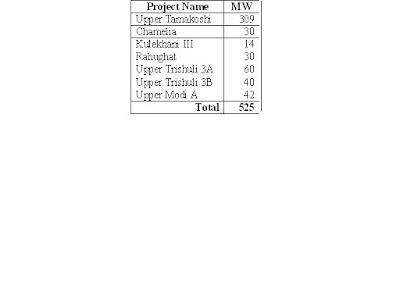


On December 7, 2008, public relations director of Nepal Electricity Authority (NEA) declared that electricity users in Nepal will be facing load shedding for next 5 years. And, as NEA had proclaimed in its latest annual report, that “it is envisioned that Nepal would be power surplus by year 2013/14,” one is led to believe that the electricity users will have to suffer for the next 5 years only and after that there will be no load shedding. What a relief! In the capacity of a consumer suffering from the vagaries of the load shedding, one would wish luck to NEA so that it will be able to keep its promise.
The reason for the respite given in the annual report was the implementation of projects, totaling 525 MW by NEA and 281 MW by the independent power producers (IPPs) by 2013/14[1]. Following is the list of projects that NEA envisages to be commissioned by 2013/14:
Table 1: Projects to be commissioned by NEA by 2013/14
Similarly, NEA expects following projects to be commissioned by IPPs by 2013/14:
Table 2: Projects to be commissioned by IPPs by 2013/14
Table 2: Projects to be commissioned by IPPs by 2013/14
In this manner, between NEA and IPPs, Nepal’s power system will see an addition of 806 MW by 2013/14. After the commissioning of Middle Marsyangdi this month Nepal’s current total installed capacity will be 687.38 (617.38 plus 70) MW and after the implementation of the above mentioned projects, the total anticipated generation capacity in the system will be 1493.38 MW by 2013/14.
Let’s now make an attempt to examine if NEA will be able to keep the promise. According to the load forecast of NEA the peak demand in 2013/14 will be 1271.7 MW and as the total capacity in the system will be 1493 MW, superficially it would seem that there will not be any need for load shedding in that year. However, even the ordinary consumers (without understanding the technicalities of electricity generation) have come to learn the hard way that during the dry season (when the demand for power reaches its peak) hydropower plants do not generate to its full capacity. Therefore, in the promised year 2013/14, the peak demand will be 1271.7 MW while with the total installed capacity of 1493.38, NEA will be able to generate only in the order of 7-8 hundred MW during the dry season. Therefore, it is rather obvious that the promised respite from load shedding in that year is almost a pipe dream due to an anticipated shortage of over 400 MW during the dry season.
Moreover, it also needs to be remembered that commissioning of 525 MW by NEA by that year will depend on timely completion of the implementation of the specified projects. NEA, unfortunately, does not have a track record of completing its hydropower projects without incurring significant time overrun since the days of Kulekhani which becomes clear from the following table.
Table 3: Delayed commissioning of projects
Furthermore, the above table also anticipates addition of 281 MW by the private sector. For this purpose the private investors need to able to execute power purchase agreements (PPAs) with NEA. From the information available till now, no PPA has been signed with any of the projects listed above. In view of this the likelihood of adding 806 MW by 2013/14 is rather remote.
To conclude, it is absolutely clear that even if the projects anticipated to be commissioned by NEA are indeed completed, the load shedding problem will continue to dog the electricity users due to the anticipated shortfall of over 400 MW in 2013/14. If the projects included in the list fail to be commissioned in time, the magnitude of load shedding even in 2013/14 will be higher. This indicates that there is something seriously wrong at various levels like, comprehension of the problem, planning to mitigate the problem and also in the implementation of the projects.
[1] Source: Fiscal Year 2007/08 – a Year in Review of NEA.
Subscribe to:
Posts (Atom)