(Courtesy: Pritam Rana)
Nepal, a multitude of petty principalities in the Himalayas, was built up into a single monolithic state by King Prithvi Narayan Shah in the 18th century . Once unified, Nepal managed to retain its sovereignty despite the presence of expansionist East India Company in the Indian plains. In the north Tibet and China were ancient polities. Nepal’s expansion following King Prithvi Narayan Shah’s death brought it into confrontation with East India Company. In the Anglo-Nepal war (1814-1816), Nepal was defeated. Earlier in 1792, in a confrontation with Tibet, Nepal was able to stop invading Chinese forces in 1792.
The rise of the Ranas after 1849 saw Nepal as a firm ally of the British interests in the subcontinent. Jung Bahadur’s support to the British facing Sepoy Mutiny of 1857 brought back Butwal plains to Nepal. Following Bhimsen Thapa’s hardline anti-Company policy would have been disastrous. Nepal’s support of Indian mutineers would have resulted into British punitive expedition against Kathmandu and subsequent occupation of Nepal. Nepal would have thus lost its sovereignty as one of the princely Indian states. The Ranas also managed to persuade Britain to recognize Nepal’s sovereignty in 1923 and Nepal was able to maintain diplomatic ties with Britain in the form of an ambassador to London. The British maintained a resident in Nepal since 1816 Sugauli Treaty.
As Mao’s communists defeated and drove Kuomintang to Formosa in 1948, a new threat emerged toward Nepal’s northern frontier. Communist China marched into Tibet in 1950 to consolidate its claim altering Nepal’s strategic scenario. At the same time, anti-Rana politicians influenced by Indian Congress sought to establish democracy and socialism, a system foreign to Nepal. Used to authoritarian centralized rule, these ideas were bound to invite radical change and threat to Nepal’s existence as an independent country.
Before India and China clashed in 1962, Nepal gave up its experimentation with democracy and established a semi-democratic polity with considerable power in the hands of King Mahendra. In the heights of the Cold War, King Mahendra chose neutral foreign policy and adherence to non-aligned movement primarily to keep Nepal away from being entangled in Sino-Indian schism. Nepal thus was isolated from Western countries, its principal friends. Foreign investement into exploiting water resources was thus not forthcoming from the rich Western countries while the masses remained poor, mainly into subsistence farming, employment into British and Indian armies and as laborers in India.
After 1990, political change was idiosyncratic. While communism failed in Eastern Europe, Nepal saw a resurgence in appeal to communist parties. Populist slogans appealed to poorer, uneducated classes and from 1996, a radical wing of Nepal’s communists, the Maoists began armed revolution in the rural areas. Political violence unleashed in Nepal cost 15,000 lives and it propelled Nepal’s Maoists into the major political party. Its radical and revolutionary ideals has brought into conflict with the old order. This movement has managed to eliminate Nepal’s royal family from power. Its current aim is to integrate its armed cadre into Nepal’s army and take control of this oldest institution of Nepal. Absolute control is the supposed goal to transform Nepal into a one party communist state.
Nepal’s democracy has been skillfully infiltrated and brutally exploited by communists. Popular King Birendra should never have yielded to demands to liberalize the political system in 1990. Without a firm mechanism to check the growth of illiberal and extremist organizations, Maoists emerged and catapulted themselves to power employing unchecked political violence. King Birendra lost his life and his family in mysterious circumstances in 2001, which harks back to times of Nepal’s bloody past coups of the 19th century. King Birendra’s brother, King Gyanendra, failed to restore order in 2006 when the drive to republic gained momentum resulting in loss of monarchy, an institution with greatest contribution to Nepal’s unification and consolidation. Loss of the King as head of the state has resulted in a leadership vacuum.
March toward federalism could end up with disintegration of the state along ethnic lines aka Bosnia Herzegovina leaving room for future discord and armed conflict. The notion of federal states within a small territory as Nepal sounds impractical. The idea of these federal states negotiating with India to export power sounds farcical. Nepal’s move toward unfamiliar terrain could well take it to a point of no return.
The neo-elite of Nepal, primarily Brahmins, does not have a lasting legacy of statesmanship. Demolishing institutions in the name of restructuring is eliminating Nepal’s identity.
In the multipolar world, Nepal may well fall into the trap of emerging powers and their national interests. China’s emergence into a world power may influence pro-China elements in Nepal into suppressing Tibetan refugees and their deportation to uncertain fate in Chinese prison camps.
Communists and Maoists are already into anti-Western line. Nepal’s water resources need massive capital injection for development if it were to sustain projects capable of meeting Nepal’s rising energy demand. The hope of creating projects to export energy will always require technical expertise from the West. Nepal’s good relations with US and EU, including its traditional special ties with UK, cannot be surrendered to suit the short term foreign policy interests of its immediate neighbors. Nepal should cooperate in regional groupings like SAARC and BIMSTEC and exploit Nepal’s unique status as a center for sustainable tourism.
Radicalization of the youth by extremist political organizations and elimination of traditional institutions will erase Nepal’s appeal as a center of its unique culture. Heated political controversies with propensity for armed conflict has already earned Nepal’s image as a failed state among Nepal’s friends and donors. Further deterioration of law and order may invite intervention by India. Nepal may lose its sovereignty the same way Tibet lost it to China and Sikkim to India. The Himalayan Kingdoms were lost to expansionist designs of neighboring powers with deteriorating conditions expediting the loss of sovereignty. Therefore it is imperative that Nepal maintain partnership with NATO to maintain its territorial integrity. Nepal could well learn more from participation in NATO operations. Also, revenue in the form of pay and security assistance would be welcome.
Under no circumstances should Nepal join Shanghai Cooperation Organization (SCO) despite shortsighted arguments like it would ensure energy supply. Russia and China who are key members of this alliance are keen to develop an anti-Western front through this new Warsaw pact. The SCO member states are mostly totalitarian dictatorships bent on suppressing political freedom and human rights. Nepal’s membership into SCO would ensure the rule of anti-democratic forces like Maoists who would be more than happy to suppress individual rights and establish authoritarian political order.
Showing posts with label National Identity. Show all posts
Showing posts with label National Identity. Show all posts
Tuesday, September 01, 2009


Tuesday, July 21, 2009
The Country Cursed by a Widow
(Courtesy: Krishna Giri)
I don’t think any Nepali will raise their eyebrows when they hear- “SATI LE SARAPEKO DESH”. Right from the unification, Nepali have witnessed ongoing severity in terms of governance. Power snatching by any means has become style in Nepal. I don’t want to go back to 17th century to dig the past. Rather I will go back to the recent past. 20 governments in 20 years; that's pretty impressive, and with all due respect, Maoist supremo has presently announced that another unity government is coming in weeks. Will Maoists allow MK to stay as a buffoon PM for next few weeks or they want MK to continue with his bizarre funny political career until the festive season? This remains a mystery as the ball is in Maoist court. Not just MK but UML is an amusing party. They don’t have any leaders to lead the party; at least, none who can win peoples hearts and votes. Enough assessments have been done about CA performance for various including former DPM to current PM and I should waste no time. The UML Party - neither capitalist nor communist. Simply, lost in ideology and leadership, particularity, after the rise of Maoists.
Successive failures to act in national interests have plunged the country into utter chaos. Having 20 PMs and almost 1000 ministers in past 20 years did not help to produce some appealing leaders. These couple of decades of democratic transition should have taught leaders to act above personal and party interests. How long is adequate for a democratic transition will remain a question in Nepal’s history. No one can escape from their moral obligation as all national parties have run this country in some stage. But why they failed and subsequently we failed? We can’t always blame our geographic features and neighbours. Being a Hindu Kingdom until recent past, is this is the nation that was really cursed by a widow? If yes, what is coming next? Astrologers failed to forecast the end of 240 years old Monarchy but can someone help us to find out when this anarchy is coming to an end? Is the curse going to diminish since the country has been already declared a secular state?
Raiding dance restaurants and casinos is not enough to maintain law and order in a country. Witch hunting has stretched to looters and abductors. People have lost faith in law and security imposers and started to take laws in their own hands. Lynching and beating of culprits may sound a relief for victims but is it the way a country should be operating? Who is to be blamed for? Who preached these teachings? What have become breeding grounds for up to 80 armed insurgent groups? What was the cause for which 15000 people died? And what were the reasons for the abolition of - Monarchy, Hindu state, Daura Suruwal to Nepali language?? There are thousands of questions to be answered by state. This country has been cursed by a widow but this can not be answers to all, can it?
Maobadi tried to tussle with big brother and the obvious result was the fall of the government. People knew that conventional fact long before Prachanda admitted honouring them, 'Bideshi Prabhu'. Even in his departing speech, he could not spell them out but rather, he identified them as god. Soon after their exit from government, their performances have gotten better; bringing the country into standstill, from streets to CA chamber. I beg your pardon but what an elegant way to exercise democracy. It has just been weeks since the fall of last government and we have already started to perceive new game about Tibet. Is it just India matters for us? Can’t we play a positive sum game between India and China? What are the consequences if China is annoyed? Is this is the pretext to fall yet another government? If a government can not sustain a year, what prosperity can we expect? Is this really is a democracy that we are exercising? We do not have any local governments for more than a decade and may remain the same for many years to come. This is the fundamental breach on norms of democracy. If we lookup to our main democratic figures, one should not be amazed by the fact that they all are autocrats. Why everything looks so wrong? Why this horde of people can not agree on national interests? Why they can not come together for economic and social prosperities? Why they can not agree to hold free and fair elections in all levels? Why peace and security of this country is not important to all? Is it because, “YO SATILE SARAPEKO DESH HO”?
I don’t think any Nepali will raise their eyebrows when they hear- “SATI LE SARAPEKO DESH”. Right from the unification, Nepali have witnessed ongoing severity in terms of governance. Power snatching by any means has become style in Nepal. I don’t want to go back to 17th century to dig the past. Rather I will go back to the recent past. 20 governments in 20 years; that's pretty impressive, and with all due respect, Maoist supremo has presently announced that another unity government is coming in weeks. Will Maoists allow MK to stay as a buffoon PM for next few weeks or they want MK to continue with his bizarre funny political career until the festive season? This remains a mystery as the ball is in Maoist court. Not just MK but UML is an amusing party. They don’t have any leaders to lead the party; at least, none who can win peoples hearts and votes. Enough assessments have been done about CA performance for various including former DPM to current PM and I should waste no time. The UML Party - neither capitalist nor communist. Simply, lost in ideology and leadership, particularity, after the rise of Maoists.
Successive failures to act in national interests have plunged the country into utter chaos. Having 20 PMs and almost 1000 ministers in past 20 years did not help to produce some appealing leaders. These couple of decades of democratic transition should have taught leaders to act above personal and party interests. How long is adequate for a democratic transition will remain a question in Nepal’s history. No one can escape from their moral obligation as all national parties have run this country in some stage. But why they failed and subsequently we failed? We can’t always blame our geographic features and neighbours. Being a Hindu Kingdom until recent past, is this is the nation that was really cursed by a widow? If yes, what is coming next? Astrologers failed to forecast the end of 240 years old Monarchy but can someone help us to find out when this anarchy is coming to an end? Is the curse going to diminish since the country has been already declared a secular state?
Raiding dance restaurants and casinos is not enough to maintain law and order in a country. Witch hunting has stretched to looters and abductors. People have lost faith in law and security imposers and started to take laws in their own hands. Lynching and beating of culprits may sound a relief for victims but is it the way a country should be operating? Who is to be blamed for? Who preached these teachings? What have become breeding grounds for up to 80 armed insurgent groups? What was the cause for which 15000 people died? And what were the reasons for the abolition of - Monarchy, Hindu state, Daura Suruwal to Nepali language?? There are thousands of questions to be answered by state. This country has been cursed by a widow but this can not be answers to all, can it?
Maobadi tried to tussle with big brother and the obvious result was the fall of the government. People knew that conventional fact long before Prachanda admitted honouring them, 'Bideshi Prabhu'. Even in his departing speech, he could not spell them out but rather, he identified them as god. Soon after their exit from government, their performances have gotten better; bringing the country into standstill, from streets to CA chamber. I beg your pardon but what an elegant way to exercise democracy. It has just been weeks since the fall of last government and we have already started to perceive new game about Tibet. Is it just India matters for us? Can’t we play a positive sum game between India and China? What are the consequences if China is annoyed? Is this is the pretext to fall yet another government? If a government can not sustain a year, what prosperity can we expect? Is this really is a democracy that we are exercising? We do not have any local governments for more than a decade and may remain the same for many years to come. This is the fundamental breach on norms of democracy. If we lookup to our main democratic figures, one should not be amazed by the fact that they all are autocrats. Why everything looks so wrong? Why this horde of people can not agree on national interests? Why they can not come together for economic and social prosperities? Why they can not agree to hold free and fair elections in all levels? Why peace and security of this country is not important to all? Is it because, “YO SATILE SARAPEKO DESH HO”?
Tuesday, April 28, 2009
India Halts Power Supply Deal – No Wonder!
(Courtesy: Ratna Sansar Shrestha)
The following was reported by myrepublica.com on 24th April:
"KATHMANDU, April 24: The action initiated by the Maoist-led government against army chief General Rookmangud Katawal and the polarized views of the political parties on the issue have now affected the power import deal between Nepal and India.The Indian government on Thursday put on hold the agreement to supply 30 MW power to Nepal just two days before it was supposed to be signed."We had finalized everything from our side. But the agreement has now been put on hold," a Nepal Electricity Authority (NEA) official told this daily. The source informed that as per the request of the Bihar Board, a letter requesting government of India´s approval on the agreement was sent to the Ministry of External Affairs in New Delhi through the Indian embassy in Kathmandu on April 22. However, the Ministry did not send a consent to the request.A week ago, the NEA had forwarded a memorandum of understanding to the Power Board of Bihar to import the additional 30 MW of electricity at the rate of IRs 4.79 per unit for a period of two months.“Both sides had settled all issues and conditions for the import,” the source added.The Power Trading Corporation (PTC) of India was making necessary arrangements for the import to Nepal via Ramnagar in Bihar.The development comes amid reports that the Indian government has been inserting pressure on the Maoist-led government in Nepal against the dismissal of the army chief.Indian ambassador to Nepal Rakesh Sood on Thursday flew to New Delhi, canceling all appointments here, to brief the South Block on the ´current developments´ in Nepal."
However, it will take a while for it to dawn on most of our hydrocracy (bureaucracy, politicos, intelligentsia, media persons, business community, bankers involved in the hydropower sector) that export of power to Nepal is an additional weapon in Indian arsenal for her against Nepal (as is the trade and transit) to ensure that Nepal toes the line, they want her to. I dare to trust that people in Nepal haven’t forgotten (although “people” are famed to have very short memory) about the trade embargo and transit blockade that India imposed on Nepal in late 80’s leading to “people’s movement I”. What ensued is in the pages of history obviating repetition here.
In the same vein, when I read about Nepal’s plan to import 500 MW from India, while I was vacationing in Vientiane with my brand new granddaughter, I had tears in my eyes trying to stop myself from laughing uncontrollably for quite a while. This was exactly what I was worried about – India using “power” (electric) to have Nepal dance to their tunes (according to their caprices). Besides, I felt sad and also felt like smiling (simultaneously!) at the tragicomic situation, after reading that PTC has offered a “generous” rate of INR 3 while Nepal is set to export at NPR 3 – offering a handsome markup of 60% straight (how magnanimous we are!). Eventually they will be importing from Nepal at Rs 3 and export the same to us at Rs 4.80 – reinforcing the firmly held belief in Indian politicos and bureaucracy that Nepali people are nice and, therefore, dumb (except for those who sell their souls for “a few silvers”).
An interesting thing about the “halt” is that it is Ministry of External Affairs in New Delhi that has thrown wrench in the works. It is surprising that simple export of power to Nepal requires approval of Ministry of External Affairs in New Delhi. However, hydrocracy of Nepal deems export of power normal trade (simply trading in “electron”) and they proclaim that exporting power does not have anything to do with water resources (even Supreme Court of Nepal has delivered a verdict in this line in the case of west Seti. When reference is being made to west Seti, it needs to be remembered that Nepal wasn’t importing 30 MW dedicated power from a specific project. However, west Seti it is dedicated export oriented project. What is more galling is that west Seti generates augmented flow of 90 m3/s which ends up benefiting farmers in India (can irrigate 270,000 ha land for non paddy cultivation), but the deal, even from this perspective was deemed not sharing of water resources.
This also calls on us to look at the other side of this very coin (export of power to India). Intransigent people (including those who would like to replicate Bhutan model in Nepal) dream of having India “jump” at our bidding by exporting power to her as she will be dependent on “us” for substantial amount of power from large plants – up to 10,000 MW from Karnali (and making Nepal "immensely" rich). I have pointed out the fallacy behind this belief in my article published in Nepali Times (# 314, 8-14 September, 2006) as “India is uncomfortable being dependent on an independent Nepal on such a scale. The comfort level would have gone up significantly if the security of such a project is to be guaranteed by the Indian Army.” With regard to Bhutan, being a protectorate of India, India does not feel uncomfortable being dependent on her. I hope I don’t need to overemphasize it here by saying that Indians would hate to lose sleep by having to wonder when someone in Nepal is going to switch off power from plants in Nepal exporting to India (exactly the reverse of what they have just done to Nepal suffering from chronic load shedding). In view of this, the idea of dedicated export oriented power plants in Nepal for India will never work as long as Nepal will fail to graciously accept Indian security arrangement of such plants in Nepal. I have gone on to opine in that article that “But Nepali people are famous for their “intransigence” in this matter” (Thank God!). I would like to believe that I am not off mark in this matter
Before concluding, I would like to repeat, ad nauseoum (since I have been repeating this over and over again) that Nepal’s best interest will be best served by ensuring energy security and being self reliant in the matters of energy – from our own water resource.
I would like to close here by reiterating that Indian interest in Nepal’s hydropower is just a façade to capture water belonging to Nepal – we can find abundant examples in Koshi, Gandaki and Mahakali treaties. My belief as such has been confirmed by current union water resources minister of India Mr. Saif Uddin Soz (no less a person) who has been frank and honest in admitting, with Navin Singh Khadka, BBC Nepali Service, 12 September 2008 that “Our main interest is flood control and irrigation. Those are our first and second priority. If we get hydroelectricity as by product, that will be a bonus for us.” I pray to god almighty that he gets elected once more and ascends the same ministerial berth in Delhi.
The following was reported by myrepublica.com on 24th April:
"KATHMANDU, April 24: The action initiated by the Maoist-led government against army chief General Rookmangud Katawal and the polarized views of the political parties on the issue have now affected the power import deal between Nepal and India.The Indian government on Thursday put on hold the agreement to supply 30 MW power to Nepal just two days before it was supposed to be signed."We had finalized everything from our side. But the agreement has now been put on hold," a Nepal Electricity Authority (NEA) official told this daily. The source informed that as per the request of the Bihar Board, a letter requesting government of India´s approval on the agreement was sent to the Ministry of External Affairs in New Delhi through the Indian embassy in Kathmandu on April 22. However, the Ministry did not send a consent to the request.A week ago, the NEA had forwarded a memorandum of understanding to the Power Board of Bihar to import the additional 30 MW of electricity at the rate of IRs 4.79 per unit for a period of two months.“Both sides had settled all issues and conditions for the import,” the source added.The Power Trading Corporation (PTC) of India was making necessary arrangements for the import to Nepal via Ramnagar in Bihar.The development comes amid reports that the Indian government has been inserting pressure on the Maoist-led government in Nepal against the dismissal of the army chief.Indian ambassador to Nepal Rakesh Sood on Thursday flew to New Delhi, canceling all appointments here, to brief the South Block on the ´current developments´ in Nepal."
However, it will take a while for it to dawn on most of our hydrocracy (bureaucracy, politicos, intelligentsia, media persons, business community, bankers involved in the hydropower sector) that export of power to Nepal is an additional weapon in Indian arsenal for her against Nepal (as is the trade and transit) to ensure that Nepal toes the line, they want her to. I dare to trust that people in Nepal haven’t forgotten (although “people” are famed to have very short memory) about the trade embargo and transit blockade that India imposed on Nepal in late 80’s leading to “people’s movement I”. What ensued is in the pages of history obviating repetition here.
In the same vein, when I read about Nepal’s plan to import 500 MW from India, while I was vacationing in Vientiane with my brand new granddaughter, I had tears in my eyes trying to stop myself from laughing uncontrollably for quite a while. This was exactly what I was worried about – India using “power” (electric) to have Nepal dance to their tunes (according to their caprices). Besides, I felt sad and also felt like smiling (simultaneously!) at the tragicomic situation, after reading that PTC has offered a “generous” rate of INR 3 while Nepal is set to export at NPR 3 – offering a handsome markup of 60% straight (how magnanimous we are!). Eventually they will be importing from Nepal at Rs 3 and export the same to us at Rs 4.80 – reinforcing the firmly held belief in Indian politicos and bureaucracy that Nepali people are nice and, therefore, dumb (except for those who sell their souls for “a few silvers”).
An interesting thing about the “halt” is that it is Ministry of External Affairs in New Delhi that has thrown wrench in the works. It is surprising that simple export of power to Nepal requires approval of Ministry of External Affairs in New Delhi. However, hydrocracy of Nepal deems export of power normal trade (simply trading in “electron”) and they proclaim that exporting power does not have anything to do with water resources (even Supreme Court of Nepal has delivered a verdict in this line in the case of west Seti. When reference is being made to west Seti, it needs to be remembered that Nepal wasn’t importing 30 MW dedicated power from a specific project. However, west Seti it is dedicated export oriented project. What is more galling is that west Seti generates augmented flow of 90 m3/s which ends up benefiting farmers in India (can irrigate 270,000 ha land for non paddy cultivation), but the deal, even from this perspective was deemed not sharing of water resources.
This also calls on us to look at the other side of this very coin (export of power to India). Intransigent people (including those who would like to replicate Bhutan model in Nepal) dream of having India “jump” at our bidding by exporting power to her as she will be dependent on “us” for substantial amount of power from large plants – up to 10,000 MW from Karnali (and making Nepal "immensely" rich). I have pointed out the fallacy behind this belief in my article published in Nepali Times (# 314, 8-14 September, 2006) as “India is uncomfortable being dependent on an independent Nepal on such a scale. The comfort level would have gone up significantly if the security of such a project is to be guaranteed by the Indian Army.” With regard to Bhutan, being a protectorate of India, India does not feel uncomfortable being dependent on her. I hope I don’t need to overemphasize it here by saying that Indians would hate to lose sleep by having to wonder when someone in Nepal is going to switch off power from plants in Nepal exporting to India (exactly the reverse of what they have just done to Nepal suffering from chronic load shedding). In view of this, the idea of dedicated export oriented power plants in Nepal for India will never work as long as Nepal will fail to graciously accept Indian security arrangement of such plants in Nepal. I have gone on to opine in that article that “But Nepali people are famous for their “intransigence” in this matter” (Thank God!). I would like to believe that I am not off mark in this matter
Before concluding, I would like to repeat, ad nauseoum (since I have been repeating this over and over again) that Nepal’s best interest will be best served by ensuring energy security and being self reliant in the matters of energy – from our own water resource.
I would like to close here by reiterating that Indian interest in Nepal’s hydropower is just a façade to capture water belonging to Nepal – we can find abundant examples in Koshi, Gandaki and Mahakali treaties. My belief as such has been confirmed by current union water resources minister of India Mr. Saif Uddin Soz (no less a person) who has been frank and honest in admitting, with Navin Singh Khadka, BBC Nepali Service, 12 September 2008 that “Our main interest is flood control and irrigation. Those are our first and second priority. If we get hydroelectricity as by product, that will be a bonus for us.” I pray to god almighty that he gets elected once more and ascends the same ministerial berth in Delhi.
Monday, January 12, 2009
Socialism and Communism Sans Austerity
(Courtesy: Shyam Prasad Adhikari)
"The last stage of socialism is communism" is what a political thinker has said. As stated by Karl Marx, "Communist society is one where each individual works according to his/her's capacity and in return takes from the society all that he or she requires." The major difference between socialist and communist system is that under the socialist system the individual gets from the society all the material benefits in proportion to his or her capacity, whereas under the communist system, because of abundance of goods and services, capabilities loose their significance enabling each member of the society to get all the benefits that an individual requires.
Nepal has been declared a republic and the present government is led by Communist Party of Nepal-Maoist. For any new government coming to power in Nepal, it has become a customary to issue directive for the maintenance of austerity measures to check public expenditures. But unfortunately, the directive remains in paper only, and is taken as a ritual by ministers and all government functionaries. As a result, no one feels responsible and accountable for monitoring and implementing it. The present government too, seems, performing the same ritual by issuing the austerity directive through the cabinet, recently. But the sad part of the story is; "Even as the government has approved a special directive through the cabinet, vowing to check unnecessary expenditures, one-third of the ministers of the current cabinet have left the country on foreign jaunts putting great pressure on public exchequer".
The country is, currently, undergoing difficult political situations and is weighted down by myriad socio-economic problems. People, in general, have started commenting on the ministers' expensive foreign tours by calling the austerity directive of the government as a "Pennywise and pound foolish" decision.
We have now a communist-led government, which believes in communism. Socialism and communism imply national ownership of the means of production and distribution. The idea of fair distribution of goods and services and also of austerity and equality are inherent in these concepts. But a highly tragic aspect of our political leaders versions of socialism and communism are that those who loudly profess them, themselves make a mockery of it by living in grand, ostentatious style and regarding themselves as a privileged class even while countless millions of Nepalis do not get a square meal and go semi-naked. Despite the periodic exhortations by exponents of socialism and communism asking people to economies all-round, in view of the unprecedented economic crisis, foreign cars and Prado jeeps are still being bought from the foreign companies for the use of ministers, MPs and bureaucrats. The cost of ministerial comfort to the public exchequer is indeed very heavy. Their salaries represent a fraction of what the nation has to spend on them and on all the pomp and show that are deemed essential whenever prime minister and ministers go on foreign tours or visit districts to inaugurate a function. Their prerequisites are so many and so out of tune with the times, that many foreign visitors wonder at the governmental extravagance, while the country is still associated with the begging bowl at international forums and in affluent countries.
The conduct of Heads of state and ministers in capitalist or non-socialist countries provides a sharp contrast. The Prime Minister of Turkey has refused to live in the spacious official residence or to use an official car; instead, he prefers to live in a modest rented apartment. The highest executive there has thus set an example of real austerity by living like a common man. But in Nepal, many of our ministers and officials insist on using luxurious cars and furnishing their official residences at heavy cost to the exchequer. The President of Switzerland travels by bus. The governors and governor-generals in Australia and Canada walk in the street like common men and never get road cleared for them. A recent example is that the President of South Korea, Mr. Li Miungbak, was seen riding an ordinary bicycle on way to his office. Mahmoud Ahmadinejad, the president of Iran, who recently announced that he would not take salary, is a glaring example of politician's sacrifice for the country.
In Nepal particularly in Kathmandu, whenever President or Prime Minister or other VIPS are to pass along a road, other people have to make way and sometimes traffic is hold-up for hours. If our VIPs live in simple style like commoners, they would be better able to realize what problems face the country. If they abandon their limousines and ivory towers, they would be true socialists and communists and not fake ones, as they are now. The yawning gap between their professions and practice does not extend to their mode of living. It is also notable in their day-to-day actions and their effort to acquire wealth and property while the sun shines. In their living styles they imitate affluent aristocracy, and in their lust for wealth they imitate the present neo-rich and in their speech they preach democracy, socialism, communism and austerity. All the sacrifices are on the people's side, comfort and luxuries on theirs.
Austerity and simplicity are postulates of democracy, socialism and communism". But it is ridiculous to see our leaders and politicians, who swear by socialism and communism every day and endlessly, call for more sacrifices by the masses. It appears that our leaders have conveniently escaped the evolutionary process of socialism and communism and are trying to achieve all the material benefits, irrespective of their contribution to the society and are trying to get all the benefits of a socialist and communist society, disregarding the fact that our social and economic systems are still in pre-industrial society stage. It is most unfortunate that our political leaders, proponent of socialism and pursuing communist ideology, preach their "Isms" to people and they themselves practice and behave like capitalists. What a socialism, communism and austerity in new Nepal !!
"The last stage of socialism is communism" is what a political thinker has said. As stated by Karl Marx, "Communist society is one where each individual works according to his/her's capacity and in return takes from the society all that he or she requires." The major difference between socialist and communist system is that under the socialist system the individual gets from the society all the material benefits in proportion to his or her capacity, whereas under the communist system, because of abundance of goods and services, capabilities loose their significance enabling each member of the society to get all the benefits that an individual requires.
Nepal has been declared a republic and the present government is led by Communist Party of Nepal-Maoist. For any new government coming to power in Nepal, it has become a customary to issue directive for the maintenance of austerity measures to check public expenditures. But unfortunately, the directive remains in paper only, and is taken as a ritual by ministers and all government functionaries. As a result, no one feels responsible and accountable for monitoring and implementing it. The present government too, seems, performing the same ritual by issuing the austerity directive through the cabinet, recently. But the sad part of the story is; "Even as the government has approved a special directive through the cabinet, vowing to check unnecessary expenditures, one-third of the ministers of the current cabinet have left the country on foreign jaunts putting great pressure on public exchequer".
The country is, currently, undergoing difficult political situations and is weighted down by myriad socio-economic problems. People, in general, have started commenting on the ministers' expensive foreign tours by calling the austerity directive of the government as a "Pennywise and pound foolish" decision.
We have now a communist-led government, which believes in communism. Socialism and communism imply national ownership of the means of production and distribution. The idea of fair distribution of goods and services and also of austerity and equality are inherent in these concepts. But a highly tragic aspect of our political leaders versions of socialism and communism are that those who loudly profess them, themselves make a mockery of it by living in grand, ostentatious style and regarding themselves as a privileged class even while countless millions of Nepalis do not get a square meal and go semi-naked. Despite the periodic exhortations by exponents of socialism and communism asking people to economies all-round, in view of the unprecedented economic crisis, foreign cars and Prado jeeps are still being bought from the foreign companies for the use of ministers, MPs and bureaucrats. The cost of ministerial comfort to the public exchequer is indeed very heavy. Their salaries represent a fraction of what the nation has to spend on them and on all the pomp and show that are deemed essential whenever prime minister and ministers go on foreign tours or visit districts to inaugurate a function. Their prerequisites are so many and so out of tune with the times, that many foreign visitors wonder at the governmental extravagance, while the country is still associated with the begging bowl at international forums and in affluent countries.
The conduct of Heads of state and ministers in capitalist or non-socialist countries provides a sharp contrast. The Prime Minister of Turkey has refused to live in the spacious official residence or to use an official car; instead, he prefers to live in a modest rented apartment. The highest executive there has thus set an example of real austerity by living like a common man. But in Nepal, many of our ministers and officials insist on using luxurious cars and furnishing their official residences at heavy cost to the exchequer. The President of Switzerland travels by bus. The governors and governor-generals in Australia and Canada walk in the street like common men and never get road cleared for them. A recent example is that the President of South Korea, Mr. Li Miungbak, was seen riding an ordinary bicycle on way to his office. Mahmoud Ahmadinejad, the president of Iran, who recently announced that he would not take salary, is a glaring example of politician's sacrifice for the country.
In Nepal particularly in Kathmandu, whenever President or Prime Minister or other VIPS are to pass along a road, other people have to make way and sometimes traffic is hold-up for hours. If our VIPs live in simple style like commoners, they would be better able to realize what problems face the country. If they abandon their limousines and ivory towers, they would be true socialists and communists and not fake ones, as they are now. The yawning gap between their professions and practice does not extend to their mode of living. It is also notable in their day-to-day actions and their effort to acquire wealth and property while the sun shines. In their living styles they imitate affluent aristocracy, and in their lust for wealth they imitate the present neo-rich and in their speech they preach democracy, socialism, communism and austerity. All the sacrifices are on the people's side, comfort and luxuries on theirs.
Austerity and simplicity are postulates of democracy, socialism and communism". But it is ridiculous to see our leaders and politicians, who swear by socialism and communism every day and endlessly, call for more sacrifices by the masses. It appears that our leaders have conveniently escaped the evolutionary process of socialism and communism and are trying to achieve all the material benefits, irrespective of their contribution to the society and are trying to get all the benefits of a socialist and communist society, disregarding the fact that our social and economic systems are still in pre-industrial society stage. It is most unfortunate that our political leaders, proponent of socialism and pursuing communist ideology, preach their "Isms" to people and they themselves practice and behave like capitalists. What a socialism, communism and austerity in new Nepal !!
Friday, January 09, 2009
Is Nepal going to Fail?
(Courtesy: Krisna Giri)
Instead of mocking Nepali leaders, this time my thoughts are going towards the country and countrymen. Bulldozed by the political and leadership changes; besieged by living and security conditions; aggravated by the false hope for water and electricity, people are going through exceptional intellectual stress than ever before. The successive government’s governance is being so underprivileged that people are abandoned by every successor. Peace, Rule of law and social harmony amongst diverse societies are fouled by various power centres. I truly wonder how this country is surviving. The Prime Minister is talking about waging another civil war. Defence Minister and Chief of Army staff announced series of ambiguous statements. A Madheshi leader is talking about end of Nepal. Janajatis are already declaring their autonomous regions. Indian Ambassador, once close friend to all parties, is holding secret meetings with former Monarch and Foreign Minister is outraged and publicly giving some sermons about diplomatic protocols. Various ethnic groups are recruiting armed combatants to wage war against the state. Few religions elements are already plotting bombs across the country. A Supreme Court judge gets lecture about rule of law and power of people. And now a Pashupati Priest becomes another victim of dirty political onslaught.
My worries at this point of time are neither leaders nor parties but the nation. We have been bombarded by nationalistic rhetoric for some years but hardly anything has been done to keep the aspiration alive. It is really hard to believe that Nepal has a democratic government. If you believe in modern capitalistic democratic society, you would assume at least ruling and opposition parties. We do have parties but may be someone can help me to identify who is ruling and who is opposing. Parties are moving their feets left, right and centre. They trying to grab every opportunity vested by political ego and ambition. In the name of democracy, the country had faced immense undemocratic stirs in the recent past. Abraham Lincoln once said: “Democracy is the government of the people, by the people, for the people”. If he was alive to witness the political hysteria in Nepal, he would have regretted the last bit, democracy for the people. And he also once said, “Ballot is stronger than the Bullet”. He would have changed his mind if he was born post Maoist era. Let’s forget about the sincerity of the government towards people, there is no evidence that the government is working for the people. The political backlashes within parties and communities have forced the country to embrace unfortunate economy, security, peace, jobs, affordability, housing etc.
The country has lost ground in a verge to collapse. A ‘Fail State’ is not a new term for us any more. These words have been thrown for discussion by numerous scholars for a while. The principal anxiety for people is this- ‘Is the country going to fail’? As a commoner, it is imperative to understand the basics of a ‘Failed State’. A Washington D.C. based NGO, Fund for Peace, defines a ‘Failed State’ as, “A failed state is a state whose central government is so weak or ineffective that it has little practical control over much of its territory; non-provision of public services; widespread corruption and criminality; refugees and involuntary movement of populations; and sharp economic decline”. All successive Nepali governments in the last decade meet the above criteria and pose enormous threat to the sovereignty of the country. It is expected from an independent country’s government that they exercise genuine control over at least the larger part of their country and population. A state should be capable to cooperate with other states, donors, international communities and govern according to the rule of law, respect international legal obligations, prevent crime etc.
The African Studies Centre, Leiden, in its report released in December 2003, send a chilling threat to the states in a path to fail. The report states, “It should be realized by policymakers that failed states, and particularly the ones that have collapsed, never return to how they were prior to breaking down, even in the event that they do succeed in regaining coherence after a period of failure”. I don’t think a patriot would ever think to lose the history, culture, nationality and identity as whole because of domestic conflicts. These conflicts motivated by political ambitions are causing widespread harm to the entire nation and has jeopardized the national harmony. We should not let the country fail.
Most states fail with internal conflicts and civil wars but that is not only the reason. In some cases, a country may fail because of foreign governments who knowingly destabilize a state by fuelling ethnic warfare or supporting rebel forces, causing it to collapse. We know the role of India during Maoist insurgency leading to the overthrow of the Monarchy. In a recent interview with Kantipur, D.P. Thripathy, an Indian leader who broke 12 points understanding with SPA in November 2005, has admitted that Indian elements want to treat Nepal as a colony. Political market is already frenzied by the China’s interest in CPN Maoists government. We need to be alarmed by too much interest expressed by world powers and our neighbours. What we need to understand is, ‘if they succeed, we fail and if they fail, we too fail’.
Instead of mocking Nepali leaders, this time my thoughts are going towards the country and countrymen. Bulldozed by the political and leadership changes; besieged by living and security conditions; aggravated by the false hope for water and electricity, people are going through exceptional intellectual stress than ever before. The successive government’s governance is being so underprivileged that people are abandoned by every successor. Peace, Rule of law and social harmony amongst diverse societies are fouled by various power centres. I truly wonder how this country is surviving. The Prime Minister is talking about waging another civil war. Defence Minister and Chief of Army staff announced series of ambiguous statements. A Madheshi leader is talking about end of Nepal. Janajatis are already declaring their autonomous regions. Indian Ambassador, once close friend to all parties, is holding secret meetings with former Monarch and Foreign Minister is outraged and publicly giving some sermons about diplomatic protocols. Various ethnic groups are recruiting armed combatants to wage war against the state. Few religions elements are already plotting bombs across the country. A Supreme Court judge gets lecture about rule of law and power of people. And now a Pashupati Priest becomes another victim of dirty political onslaught.
My worries at this point of time are neither leaders nor parties but the nation. We have been bombarded by nationalistic rhetoric for some years but hardly anything has been done to keep the aspiration alive. It is really hard to believe that Nepal has a democratic government. If you believe in modern capitalistic democratic society, you would assume at least ruling and opposition parties. We do have parties but may be someone can help me to identify who is ruling and who is opposing. Parties are moving their feets left, right and centre. They trying to grab every opportunity vested by political ego and ambition. In the name of democracy, the country had faced immense undemocratic stirs in the recent past. Abraham Lincoln once said: “Democracy is the government of the people, by the people, for the people”. If he was alive to witness the political hysteria in Nepal, he would have regretted the last bit, democracy for the people. And he also once said, “Ballot is stronger than the Bullet”. He would have changed his mind if he was born post Maoist era. Let’s forget about the sincerity of the government towards people, there is no evidence that the government is working for the people. The political backlashes within parties and communities have forced the country to embrace unfortunate economy, security, peace, jobs, affordability, housing etc.
The country has lost ground in a verge to collapse. A ‘Fail State’ is not a new term for us any more. These words have been thrown for discussion by numerous scholars for a while. The principal anxiety for people is this- ‘Is the country going to fail’? As a commoner, it is imperative to understand the basics of a ‘Failed State’. A Washington D.C. based NGO, Fund for Peace, defines a ‘Failed State’ as, “A failed state is a state whose central government is so weak or ineffective that it has little practical control over much of its territory; non-provision of public services; widespread corruption and criminality; refugees and involuntary movement of populations; and sharp economic decline”. All successive Nepali governments in the last decade meet the above criteria and pose enormous threat to the sovereignty of the country. It is expected from an independent country’s government that they exercise genuine control over at least the larger part of their country and population. A state should be capable to cooperate with other states, donors, international communities and govern according to the rule of law, respect international legal obligations, prevent crime etc.
The African Studies Centre, Leiden, in its report released in December 2003, send a chilling threat to the states in a path to fail. The report states, “It should be realized by policymakers that failed states, and particularly the ones that have collapsed, never return to how they were prior to breaking down, even in the event that they do succeed in regaining coherence after a period of failure”. I don’t think a patriot would ever think to lose the history, culture, nationality and identity as whole because of domestic conflicts. These conflicts motivated by political ambitions are causing widespread harm to the entire nation and has jeopardized the national harmony. We should not let the country fail.
Most states fail with internal conflicts and civil wars but that is not only the reason. In some cases, a country may fail because of foreign governments who knowingly destabilize a state by fuelling ethnic warfare or supporting rebel forces, causing it to collapse. We know the role of India during Maoist insurgency leading to the overthrow of the Monarchy. In a recent interview with Kantipur, D.P. Thripathy, an Indian leader who broke 12 points understanding with SPA in November 2005, has admitted that Indian elements want to treat Nepal as a colony. Political market is already frenzied by the China’s interest in CPN Maoists government. We need to be alarmed by too much interest expressed by world powers and our neighbours. What we need to understand is, ‘if they succeed, we fail and if they fail, we too fail’.
Tuesday, September 30, 2008
West Seti Project - a Nepali Perspective
(Courtesy: Ratna Sansar Shrestha, FCA)
Although, there is no information available on the quantum of flood control benefit, but 90 m3/s of augmented flow during the dry season is worth $ 83 million (equivalent to Rs 5.81 billion) annually based on the principle set forth by the agreement between Lesotho and South Africa[i] for the purpose. We could also develop a mechanism to share such benefit on the precedent set by the Columbia Treaty.
Under Article V: “Entitlement to Downstream Power Benefits” of this treaty “Canada is entitled to one half the downstream power benefits”. The downstream power benefit has been defined by Article VII as “the difference in the hydroelectric power capable of being generated in the United States of America with and without the use of Canadian storage.” Drawing a parallel with the West Seti project, as the installed capacity of this project without a reservoir is just 100 MW, the power benefit of the construction of the reservoir is 650 MW and Nepal, under the principle established by this Treaty, is entitled to 325 MW.
Similarly, under Article VI of this treaty Canada gets a lump sum of $ 64,400,000 as “Payment for Flood Control” from USA. Additionally “the United States of America shall pay Canada in United States funds in respect only of each of the first four flood periods for which a call is made 1,875,000 dollars and shall deliver to Canada in respect of each and every call made, electric power equal to the hydroelectric power lost by Canada as a result of operating the storage to meet the flood control need for which the call was made,” moreover, under Clause (b) of Section 4 of this article US is required to pay to Canada a “compensation for the economic loss to Canada arising directly from Canada foregoing alternative uses of the storage used to provide the flood control.”
Unfortunately, the extant paper work between Nepal and the proponents of West Seti project has deprived Nepal of these innate rights. Nepal deserves to be recompensed for the downstream augmented benefit based on the lines of agreement between Lesotho and South Africa or on the basis of the precedent set by the Columbia Treaty. Failing to emulate the principles set in one of these treaties, there is no point in implementing this project.
Climate Change – Carbon Offset
Emission of carbon dioxide from the use of fossil fuel has resulted in global warming in a larger scale which in turn has induced climate change. In order to mitigate this problem, the Clean Development Mechanism (CDM) has been put in place which is a mechanism within the Kyoto Protocol that allows industrialized Annex I countries to implement projects that reduce emissions in non-Annex I countries (developing countries) and get credits for meeting their commitments to reduce emissions.
Generation of hydropower does result in environmental additionality due to carbon offset by it, in not emitting green house gases (GHG) in environment. As envisaged by Kyoto Protocol, trading in such carbon offset, also known as carbon credit, is already taking place. However, as Nepal is bereft of any fossil fuel exploration activity, and its use of such polluting source of energy as a source of energy is negligible and, therefore, Nepal’s baseline is deemed to be the hydropower which doesn’t pollute. Because, under Kyoto Protocol, a country like Nepal with hydropower as its baseline, environmental additionality is not deemed to be accrued by generating additional hydropower for domestic use, except in the case of hydropower plant of up to 15 MW. Therefore, most of the projects are not considered to be generating environmental additionality. Whereas, as West Seti project exports “clean” power to a country whose baseline is not hydropower, the transaction does succeed in offsetting carbon dioxide.
In view of this, export of hydropower from Nepal to India is a good candidate for trading in such carbon credits for which West Seti project is in a comparatively better position to do so. Of the annual generation of 3,636 GWh, this project is obliged to provide 10% to Nepal free of cost and it will be exporting 3,272 GWh to India each year. As one liter of diesel generates, generally, 4 kWh of electricity, export of power from West Seti will displace 818,100,000 liters of diesel each year in India for generation of power. As the emission factor for carbon dioxide (CO2) for diesel is 2.68 kg per liter[ii], consumption of 3272 GWh of electricity imported from Nepal will offset 2,192,508 tons of CO2 in a year in India. Similarly, as diesel also emits Nitrous Oxide (N2O) and Methane (CH4) besides CO2 and the emission factor as given in the IPCC[iii] for N2O is 0.032 kg CO2 equivalent per liter of diesel with global warming potential (GWP) of 300 and 0.004 kg CO2 equivalent per liter of diesel for CH4 emissions with GWP of 21. Therefore, the export of 3,272 GWh to India each year will also offset N2O by 26,179 tons of CO2 equivalent and CH4 by 3,272 tons of CO2 equivalent. In total the export of electricity from this project will offset by 2,221,960 tons of CO2 equivalent in a year. Such carbon offset has a market under Kyoto Protocol. Although the price of carbon offset ranges between $ 5-15 per ton of CO2 equivalent, for the sake of simplicity, using a median price of $ 10 per ton of CO2 equivalent yields a revenue stream of $ 22.2 million (equivalent to Rs 1.55 billion) per annum.
In view of the numerous benefits, as described above, that construction of this project will educe this is definitely one of the best projects of the genre. However, benefits don’t come alone and there are always numerous and matching costs.
The Costs
But there are costs (beyond the initial investment) involved in building this project in terms of environmental degradation, submergence of forest, cultivable land, etc. that Nepal will have to bear. The project’s reservoir inundates/submerges 25.1 km of the Seti River and a total of 28.0 km of five main tributaries (Chama Gad, Dhung Gad, Saili Gad, Nawaghar Gad, and Kalanga Gad) which displaces 18,289 people[iv]. According to the same report “The permanent project features will require the acquisition” of 659 ha cultivated land, 806 ha forest, 169 ha shrubs, 246 ha grassland, 9 ha abandoned land, 5 ha settlement, 409 ha river feat. and 23 ha rock/cliffs/screes totaling 2,326 ha of land[v]. Similarly, 678 ha will be “utilized for the transmission line ROW.” In total the project will use 3004 ha land permanently. The acquisition of land as such is covered by the EIA report. The project proponent has plans on the anvil to rehabilitate the displaced people by providing land in lieu of cultivated land. However, the land occupied/cultivated by the displaced populace is just 659 ha of cultivated land, comprising 22% of total land to be acquired. In order to rehabilitate the displaced people, the project will be providing land in lieu for the cultivated land in Nepal. In this manner the project will be using Nepal’s additional land for the purposes of rehabilitation. However, the project has no plans to provide land in lieu of remaining 2345 ha land (3004 ha minus 659 ha) that the project is to use. An important question that arises is why Nepal should sacrifice 2345 ha land to provide good quality low cost power to India, which will also enjoy the benefit of flood control in rainy season and augmented flow in the dry season.
But, according to Dr Anand Bahadur Thapa, additional 1,630 ha land gets submerged permanently and 645 ha partially in Banke district, in Holiya, Bethani, Gangapur, Matehiya and Phattepur VDCs, resulting in displacement of 15,174 people, due to Laxmanpur “barrage” in India coupled with the augmented flow. This is not covered by the EIA report and, therefore, no rehabilitation plan has been put in place. This raises the question as to why an institution like ADB is associating itself with such a project. One is forced to wonder if it is happening with its concurrence or complicity.
Clause 7.2(d) of the Project Agreement and Rule 20 of Electricity Regulations, 2050 puts restriction on consumptive use of water in the upstream area in order to ensure adequate water for the project to generate electricity. This restriction adversely impacts following VDCs which will not be allowed to use water in the upstream area for consumptive uses like irrigation etc: Rayal, Dangaji, Parakatne, Bhairabnath, Chaughari, Kotbhairab, Malumela, Matela, Subeda, Luyata, Hemantabada, Chainpur, Sunkuda, Banjh, Khiratadi, Dahabagar, Pipalkot and Kapalseri in Bajhang District, Belapur in Dadeldhura District, Shivalinga, Dhungad, Sigas and Thalakada in Baitadi District and Lamikhal, Mahadevsthan, Dahalkakikasthan, Girichauka & Chhapali in Doti District. The project people are trying to undermine the importance of the issue by saying that there will not be any restriction on drawing of water by the people in these villages for the purposes of drinking. The important issue here is the water for irrigation purposes. Due to the restriction imposed by Clause 7.2(d) of the Project Agreement and Rule 20 of Electricity Regulations, 2050 no new irrigation work will be allowed to be undertaken in these villages. Their attempt to obfuscate the mater will not help the project. Rather, this is the best way to lose their own credibility in the eyes of the people adversely impacted by the project in particular and others in general. Water also will become unavailable for use by locals in the de-watered area which adversely impacts Bayarpada, Banlek, Jijaudamandu, Latamandu and Pachanali VDCs in Doti District and Belapur in Dadeldhura District. The environmental flow of 10% that the project is required to leave in the dewatered area will not be adequate for the residents of the villages on the banks of the dewatered river to undertake irrigation work.
Allocation of Benefit and Cost
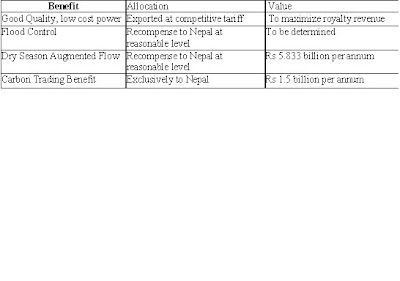
After having established the various benefits and costs of the project it is time to assess how such benefits and costs are allocated, which is depicted in the table below: 
In this backdrop one wonders why Nepal is determined to go ahead with this project! The transfer of the power plant to Nepal after 30 years, free of cost has been used (even by the Supreme Court) to justify Nepal internalizing all the costs mentioned above to export peak-in energy at rock bottom price. However, India will keep flood control and augmented flow benefits permanently (even after handover of the plant in 30 years) as “existing prior consumptive use” principle will kick in while Nepal will lose 3004 ha under the reservoir and 1,630 ha permanently, 645 ha partially in Banke due to Laxmanpur “barrage” coupled with the augmented flow to India. In this backdrop it is hard to accept that even Supreme Court verdict has served national interest.
What has been said by the project proponents (echoed with glee by Nepal’s hydrocracy) is that Nepal will receive a project worth $ 1.2 billion free of cost in 30 years. This has got a cross section of Nepali hydrocracy enthralled which has succeeded in spreading the contagion to the uninformed general public. It needs to be remembered that the Present value of $ 1.2 billion to be received in 30-year hence is just $ 68.77 million – not a huge amount worth to be excited about. Similarly, looking at it from another perspective, depreciated value of the asset worth $ 1.2 billion today in 30 years is just, again, $ 48 million (after depreciating the property for 24 years). As the old saying goes, it will be tantamount to people going about bragging about having put on some weight while it was merely a case of swelling of the body. Because, thirdly, by then, although the civil works part may be in a fairly good condition but same will not be true in the case of electro-mechanical equipment which needs to be replaced in 25-30 years.
On the contrary Nepal stands to be shortchanged of $ 2.075 billion (at current price level) for the augmented flow of water over 25 years[ix], even if Nepal is to get back the augmented flow too after the handover of the project. Similarly, Nepal also is not going to receive $ 555 million for the carbon offset during 25 years operation of the plant that she is entitled to. Moreover, it also needs to be remembered that this calculation does not take into account the power benefit that is due to Nepal.
In this scenario, Nepal does not get what is rightfully due to it. But even after hand over of the project India will continue to keep benefit from flood control as well as from the augmented flow. She will end up having right to these permanently as she will use the principle of “existing prior consumptive use.” In Nepal’s case, the land inundated by the reservoir and Laxmanpur barrage will continue to remain unavailable to her permanently, till decommissioning of the plant.
Decommissioning
Besides, there is the issue of decommissioning[x] which both the hydrocracy and the project people don’t like to talk. Although the main source of Kulekhani reservoir, for example, is not based on silt laden river, the dead storage of this reservoir is already 25%. In other words, the capacity of Kulekhani reservoir has diminished to 75% of original capacity in about 2 decades. Seti River carries high silt load and West Seti project will transform into a run-of-the-river project from the reservoir project in about 30-40 years. At that time, after getting it handed over to Nepal, this project’s dam will have to be decommissioned. As the private sector has not provided any budget for this purpose, the government of Nepal will be forced to spend money for this purpose. Meaning, when Nepal is supposed to be “enjoying” electricity from this project handed over free of cost, she will be forced to shell out money for decommissioning which will cost more than the initial investment to build this project.
Part II: Economic Assessment
An objective assessment of a project also needs its economic assessment. The best way to do so is by examining/analyzing various linkages to the economy like backward, forward, investment and fiscal linkages of the specific projects. As the reader have already perused this issue in my paper titled “Irrelevant debate of small vs. big”, only the mark sheet is recapitulated below:
Mark-sheet
 The proponents of the project seem to be trying to obfuscate the important (with high value for Nepal) issues by citing indirect benefits to Nepal in terms of employment generation etc. occurring during construction period which automatically occur in the alternative models recommended above. Similarly, they have a litany of “anticipated spin off benefits” which too does take place in the recommended models above.
Footnotes:
[i] South Africa pays to Lesotho a lump sum $25 million (in 1991 prices) each year for 18 m3/s water from Lesotho Highlands Water Project.
[ii] http://www.defra.gov.uk/environment/envrp/gas/10.htm
[iii] http://www.ipcc-nggip.iges.or.jp/EFDB/find_ef.php
[iv] Source: Environmental Assessment Report, prepared by West Seti Hydro Limited for ADB.
[v] As specified in “Table 3: Land Use on Sites to be Permanently Acquired” of Environmental Assessment Report prepared by West Seti Hydro Limited for ADB.
[vi] First signed away in the name of MoU for Tanakpur power project, but after the intervention of Supreme Court, in the name of package deal, Nepal was betrayed by signing a treaty for the whole Mahakali River which was even ratified by the Parliament – an act of national betrayal.
[vii] A transcript of the interview has been published in Nepali Times weekly, 19-25 Sept 2008, #418.
[viii] Source: “Revised Agreement between His Majesty's Government of Nepal and The Government of India on The Kosi Project.”
[ix] Based on the precedent set by the agreement between Lesotho and South Africa.
[x] Decommissioning means either stopping production of electricity from the plant or the demolition of the civil and electric infrastructure in order to restore the river ecosystem, minimize or eliminate safety hazards and put the river and land resources back to economically productive uses, when the useful life of the project expires.
West Seti project is one of the best projects of the genre, because it not only generates 3,636 GWh of peak-in energy (750 MW of power) – good quality power – but such power at low cost and also results in flood control in downstream areas, mainly India and dry season augmented flow of 90 m3/s. Moreover, export of hydropower to India from this project results in carbon offset benefit which is tradable and is a good source of revenue.
Part I: Benefits, costs and allocation thereof
Downstream Benefits and Power Benefit
Part I: Benefits, costs and allocation thereof
Downstream Benefits and Power Benefit
Although, there is no information available on the quantum of flood control benefit, but 90 m3/s of augmented flow during the dry season is worth $ 83 million (equivalent to Rs 5.81 billion) annually based on the principle set forth by the agreement between Lesotho and South Africa[i] for the purpose. We could also develop a mechanism to share such benefit on the precedent set by the Columbia Treaty.
Under Article V: “Entitlement to Downstream Power Benefits” of this treaty “Canada is entitled to one half the downstream power benefits”. The downstream power benefit has been defined by Article VII as “the difference in the hydroelectric power capable of being generated in the United States of America with and without the use of Canadian storage.” Drawing a parallel with the West Seti project, as the installed capacity of this project without a reservoir is just 100 MW, the power benefit of the construction of the reservoir is 650 MW and Nepal, under the principle established by this Treaty, is entitled to 325 MW.
Similarly, under Article VI of this treaty Canada gets a lump sum of $ 64,400,000 as “Payment for Flood Control” from USA. Additionally “the United States of America shall pay Canada in United States funds in respect only of each of the first four flood periods for which a call is made 1,875,000 dollars and shall deliver to Canada in respect of each and every call made, electric power equal to the hydroelectric power lost by Canada as a result of operating the storage to meet the flood control need for which the call was made,” moreover, under Clause (b) of Section 4 of this article US is required to pay to Canada a “compensation for the economic loss to Canada arising directly from Canada foregoing alternative uses of the storage used to provide the flood control.”
Unfortunately, the extant paper work between Nepal and the proponents of West Seti project has deprived Nepal of these innate rights. Nepal deserves to be recompensed for the downstream augmented benefit based on the lines of agreement between Lesotho and South Africa or on the basis of the precedent set by the Columbia Treaty. Failing to emulate the principles set in one of these treaties, there is no point in implementing this project.
Climate Change – Carbon Offset
Emission of carbon dioxide from the use of fossil fuel has resulted in global warming in a larger scale which in turn has induced climate change. In order to mitigate this problem, the Clean Development Mechanism (CDM) has been put in place which is a mechanism within the Kyoto Protocol that allows industrialized Annex I countries to implement projects that reduce emissions in non-Annex I countries (developing countries) and get credits for meeting their commitments to reduce emissions.
Generation of hydropower does result in environmental additionality due to carbon offset by it, in not emitting green house gases (GHG) in environment. As envisaged by Kyoto Protocol, trading in such carbon offset, also known as carbon credit, is already taking place. However, as Nepal is bereft of any fossil fuel exploration activity, and its use of such polluting source of energy as a source of energy is negligible and, therefore, Nepal’s baseline is deemed to be the hydropower which doesn’t pollute. Because, under Kyoto Protocol, a country like Nepal with hydropower as its baseline, environmental additionality is not deemed to be accrued by generating additional hydropower for domestic use, except in the case of hydropower plant of up to 15 MW. Therefore, most of the projects are not considered to be generating environmental additionality. Whereas, as West Seti project exports “clean” power to a country whose baseline is not hydropower, the transaction does succeed in offsetting carbon dioxide.
In view of this, export of hydropower from Nepal to India is a good candidate for trading in such carbon credits for which West Seti project is in a comparatively better position to do so. Of the annual generation of 3,636 GWh, this project is obliged to provide 10% to Nepal free of cost and it will be exporting 3,272 GWh to India each year. As one liter of diesel generates, generally, 4 kWh of electricity, export of power from West Seti will displace 818,100,000 liters of diesel each year in India for generation of power. As the emission factor for carbon dioxide (CO2) for diesel is 2.68 kg per liter[ii], consumption of 3272 GWh of electricity imported from Nepal will offset 2,192,508 tons of CO2 in a year in India. Similarly, as diesel also emits Nitrous Oxide (N2O) and Methane (CH4) besides CO2 and the emission factor as given in the IPCC[iii] for N2O is 0.032 kg CO2 equivalent per liter of diesel with global warming potential (GWP) of 300 and 0.004 kg CO2 equivalent per liter of diesel for CH4 emissions with GWP of 21. Therefore, the export of 3,272 GWh to India each year will also offset N2O by 26,179 tons of CO2 equivalent and CH4 by 3,272 tons of CO2 equivalent. In total the export of electricity from this project will offset by 2,221,960 tons of CO2 equivalent in a year. Such carbon offset has a market under Kyoto Protocol. Although the price of carbon offset ranges between $ 5-15 per ton of CO2 equivalent, for the sake of simplicity, using a median price of $ 10 per ton of CO2 equivalent yields a revenue stream of $ 22.2 million (equivalent to Rs 1.55 billion) per annum.
In view of the numerous benefits, as described above, that construction of this project will educe this is definitely one of the best projects of the genre. However, benefits don’t come alone and there are always numerous and matching costs.
The Costs
But there are costs (beyond the initial investment) involved in building this project in terms of environmental degradation, submergence of forest, cultivable land, etc. that Nepal will have to bear. The project’s reservoir inundates/submerges 25.1 km of the Seti River and a total of 28.0 km of five main tributaries (Chama Gad, Dhung Gad, Saili Gad, Nawaghar Gad, and Kalanga Gad) which displaces 18,289 people[iv]. According to the same report “The permanent project features will require the acquisition” of 659 ha cultivated land, 806 ha forest, 169 ha shrubs, 246 ha grassland, 9 ha abandoned land, 5 ha settlement, 409 ha river feat. and 23 ha rock/cliffs/screes totaling 2,326 ha of land[v]. Similarly, 678 ha will be “utilized for the transmission line ROW.” In total the project will use 3004 ha land permanently. The acquisition of land as such is covered by the EIA report. The project proponent has plans on the anvil to rehabilitate the displaced people by providing land in lieu of cultivated land. However, the land occupied/cultivated by the displaced populace is just 659 ha of cultivated land, comprising 22% of total land to be acquired. In order to rehabilitate the displaced people, the project will be providing land in lieu for the cultivated land in Nepal. In this manner the project will be using Nepal’s additional land for the purposes of rehabilitation. However, the project has no plans to provide land in lieu of remaining 2345 ha land (3004 ha minus 659 ha) that the project is to use. An important question that arises is why Nepal should sacrifice 2345 ha land to provide good quality low cost power to India, which will also enjoy the benefit of flood control in rainy season and augmented flow in the dry season.
But, according to Dr Anand Bahadur Thapa, additional 1,630 ha land gets submerged permanently and 645 ha partially in Banke district, in Holiya, Bethani, Gangapur, Matehiya and Phattepur VDCs, resulting in displacement of 15,174 people, due to Laxmanpur “barrage” in India coupled with the augmented flow. This is not covered by the EIA report and, therefore, no rehabilitation plan has been put in place. This raises the question as to why an institution like ADB is associating itself with such a project. One is forced to wonder if it is happening with its concurrence or complicity.
Clause 7.2(d) of the Project Agreement and Rule 20 of Electricity Regulations, 2050 puts restriction on consumptive use of water in the upstream area in order to ensure adequate water for the project to generate electricity. This restriction adversely impacts following VDCs which will not be allowed to use water in the upstream area for consumptive uses like irrigation etc: Rayal, Dangaji, Parakatne, Bhairabnath, Chaughari, Kotbhairab, Malumela, Matela, Subeda, Luyata, Hemantabada, Chainpur, Sunkuda, Banjh, Khiratadi, Dahabagar, Pipalkot and Kapalseri in Bajhang District, Belapur in Dadeldhura District, Shivalinga, Dhungad, Sigas and Thalakada in Baitadi District and Lamikhal, Mahadevsthan, Dahalkakikasthan, Girichauka & Chhapali in Doti District. The project people are trying to undermine the importance of the issue by saying that there will not be any restriction on drawing of water by the people in these villages for the purposes of drinking. The important issue here is the water for irrigation purposes. Due to the restriction imposed by Clause 7.2(d) of the Project Agreement and Rule 20 of Electricity Regulations, 2050 no new irrigation work will be allowed to be undertaken in these villages. Their attempt to obfuscate the mater will not help the project. Rather, this is the best way to lose their own credibility in the eyes of the people adversely impacted by the project in particular and others in general. Water also will become unavailable for use by locals in the de-watered area which adversely impacts Bayarpada, Banlek, Jijaudamandu, Latamandu and Pachanali VDCs in Doti District and Belapur in Dadeldhura District. The environmental flow of 10% that the project is required to leave in the dewatered area will not be adequate for the residents of the villages on the banks of the dewatered river to undertake irrigation work.
Allocation of Benefit and Cost
After having established the various benefits and costs of the project it is time to assess how such benefits and costs are allocated, which is depicted in the table below:
From the above table it is clear that all of the costs have to be borne by Nepal while benefits go to India making one wonder why Nepal is allowing implementation of such a project. The question that occurs to patriotic/nationalist Nepali people is why should Nepal sacrifice 4,634 ha of land permanently and 645 ha partially in order to provide (a) good quality power at low cost, (b) flood control and augmented dry season flow free of cost to India and (c) also carbon offset benefit to India. As a country there is sense in inundating its land mass in one area in order to benefit other area in terms of flood control and augmented flow which will make multiple cropping possible, including off season planting of high value agricultural produces. But that is not the case here.
As the issue of good quality power at low cost to India is dealt with below, the issue of flood control and augmented flow will be briefly discussed here. It does not require the knowledge of rocket science to understand that building a reservoir – to store the rainy season water and use it during the dry season – does indeed result in flood control during the wet (rainy) season and augmented flow during the dry season. In view of the fact that Seti is a relatively small river compared to Karnali (Ghagra in India) River, although the flood control benefit by building the reservoir will definitely accrue, but may not be highly significant.
However, there is no doubt whatsoever that the retaining water of the rainy season in the reservoir built for electricity generation will augment the flow in the Seti River in the dry season and, consequently, in Karnali in Nepal and Ghagra in India substantially. As 75% of the dry season flow of Ganga River is contributed by rivers in Nepal, Karnali being one of the major ones, the incremental flow will be significant. Only issue that needs to be settled is the quantum of such augment flow, objectively. Dr Anand B Thapa, an eminent scholar, has opined that it will amount to 90 m3/s while others feel that this is slightly overestimated quantum. The issue that needs to be debated is not how much will be augmented – which can be scientifically assessed – but why should Nepal have its land, forest, infrastructure, etc. submerged and have its populace displaced in order to provide additional fresh water to India free of cost. There are people in Nepal who are happy to surrender everything to India, even Nepal’s sovereignty, while paying lip service -cf]7] eQmL_ to the spirit of working to the best interest of Nepal and its people. But the majority, thankfully, will never agree to the sell out of Nepal’s interest in any form. Unfortunately, the majority is neither well informed nor is in a position to stop the hydrocracy (politicos, bureaucracy and intellectuals involved in water resource sector development) from signing away Nepal’s interest, in treaty after treaty; manifesting in the treaties for Nepal’s major rivers like Koshi, Gandaki and Mahakali[vi]. That was a phase where such bi-national treaties were signed and a lot of controversy raised. These people, with the inclusion of Article 126 in the Constitution of 1990 (Article 156 in Interim Consitution), requiring ratification of such treaties by simple majority in the case of treaties of ordinary nature and by two-thirds in the case of treaties that affect the nation extensively, seriously or in the long term, have changed track. They are now putting forth fronting companies which secure Indian interest in Nepal’s water by getting licenses for hydropower. Thus in the name of hydropower development, Nepal’s land, forest, infrastructure, etc. is submerged and have its populace displaced to provide flood control benefit and augmented flow in the dry season free of cost to India.
India's union water resources minister Mr. Saif Uddin Soz had been frank and honest in admitting, with Navin Singh Khadka, BBC Nepali Service, 12 September 2008, that “Our main interest is flood control and irrigation. Those are our first and second priority. If we get hydroelectricity as by product, that will be a bonus for us.”[vii] This is the first time that an Indian official (of highest level) has been candid in admitting as much. Surprisingly, however, this has yet to be understood by Nepal’s hydrocracy. Or it may be a case of them pretending not to understand it, in order ensure that Indian interest is served by implementing projects in the name of hydropower that afford flood control benefit and augmented flow at no cost to India. What galls ordinary Nepali citizenry is the fact that these people parrot the statement that they are working to serve the best interest of Nepal and its people while betraying the nation and the population no end.
This breed of “patriotic” people even sarcastically dismiss the issue by saying that the water from the tailrace of the West Seti project will not just jump into Indian territory and go on to add that between the tailrace and Indian territory the augmented flow traverses over 100 km of Nepali territory. What they don’t admit is the fact that if West Seti project isn’t built as a multipurpose project, with an objective to irrigate Nepali land by using the augmented flow, the augmented flow will fall in Indian lap as a low hanging, ripe fruit, and after using such water during a couple of seasons, they will have a strong case to invoke the principle of “existing prior consumptive use.” It is well known by now that using this very principle the water from Mahakali River – deemed to be a border river and each country being entitled to half water – India got away with 96.5% water and leaving just 3.5% for Nepal. Interestingly, this breed of people even come to the defense of the treaty – and by extension India – by arguing that it doesn’t make sense for Nepali people to clamor for 50% share of the water when Nepal isn’t even able to use 3.5% (such is their patriotism!).
They further demonstrate their “patriotism” by adding that even the water in the rivers flowing in Nepali territory – forget the border rivers – does not exclusively belong to Nepal. They profess to subscribe to the principle of “international water course” and assert that India too has right to the water in such rivers in Nepal. If that is the case then Nepal too has right to the water in Nepali rivers while they are flowing in China. But they never dare to raise voice as such, except to assert Indian right over the water in the rivers in Nepal. This is a shockingly subservient view, as Indian government has already acceded that “HMG shall have every right to withdraw for irrigation and for any other purpose in Nepal water from the Kosi river and from the Sun-Kosi river or within the Kosi basin from any other tributaries of the Kosi river as may be required from time to time. The Union shall have the right to regulate all the balance of supplies in the Kosi river at the barrage site thus available from time to time and to generate power in the Eastern Canal” pursuant to Clause 4 (i) of Koshi Agreement[viii]. It is clear that these people are – advertently or inadvertently – furthering Indian interest, but the Indian government does not seem to subscribe to the principle these very people swear by. Otherwise India wouldn’t have built the Farakka barrage to divert water from Ganga River to Kolkata, thus depriving Bangladesh of the water she is rightfully entitled to – thereby leaving the Dhaka port high and (literally!) dry.
Even if one was to accept the logic of international water course, the augmented flow will not be the “same” water. What the proponents of this concept need to understand is that the augmented flow generated by storing it in a reservoir inundating Nepal’s land is the water with temporal value added by Nepal. Therefore, Nepal is entitled to the “value” that has been created/added by way of storage of such water in Nepali territory. The problem lies in their mindset that the water flows down to India anyways -au]/ pt} hfg]_. The water that flows down during the normal course is the water which is devoid of any value addition. Such water even causes flood during rainy season. But by building a reservoir additional value has been created/added on the free flowing water. Therefore, Nepal is entitled to a “fee” for the value added as such. People advocating allowing such value added water to India free cost can in no way be deemed to be working for the interest of Nepal and its people. This thinking on their part is the other half of the oxymoron statement that the water normally flowing in the river is waste of “valuable” water. They don’t tire of attributing value (hence the relevance of wastage) to the normally flowing water which is bereft of any value addition (neither spatial, nor temporal) but are adamant to bestow value added water free of cost to India.
Carbon offset does indeed occur by the export of hydropower from Nepal to India. It is also true that, due to submerged vegetation in the reservoir, methane is indeed generated by the reservoir. If the carbon offset by the former is more than carbon equivalent emitted by the latter, then there is considerable value in such carbon offset. A pragmatic approach on the part of Nepali hydrocracy would have been to ensure that Nepal isn’t shortchanged of the proceeds of carbon trading emanating from the export of hydropower from West Seti project. But this section of hydrocracy that profess their love for Nepal, wish that no question like this is raised such that Indian establishment becomes annoyed at the ineffectiveness of Nepali hydrocracy in protecting the Indian interest. West Seti project management opines that carbon offset hasn’t been traded for projects larger than 200 MW. There are two issues: One, there is no harm in trying for a larger project. Two, it is incumbent on the part of GoN to ensure that if any carbon offset from this project is traded in the future, Nepal’s rights are protected.
Therefore, under the arrangement for West Seti project, Nepal gets shortchanged in many ways. She has to internalize various costs like inundation/submergence by the reservoir and in Banke district, displacement of people by the reservoir and in Banke district, restriction on consumptive (irrigation) use of water in upstream area, unavailability of water in de-watered area to irrigate. While providing good quality power to India at low cost on top of providing benefit from flood control, augmented flow and carbon trading.
Allurement
As the issue of good quality power at low cost to India is dealt with below, the issue of flood control and augmented flow will be briefly discussed here. It does not require the knowledge of rocket science to understand that building a reservoir – to store the rainy season water and use it during the dry season – does indeed result in flood control during the wet (rainy) season and augmented flow during the dry season. In view of the fact that Seti is a relatively small river compared to Karnali (Ghagra in India) River, although the flood control benefit by building the reservoir will definitely accrue, but may not be highly significant.
However, there is no doubt whatsoever that the retaining water of the rainy season in the reservoir built for electricity generation will augment the flow in the Seti River in the dry season and, consequently, in Karnali in Nepal and Ghagra in India substantially. As 75% of the dry season flow of Ganga River is contributed by rivers in Nepal, Karnali being one of the major ones, the incremental flow will be significant. Only issue that needs to be settled is the quantum of such augment flow, objectively. Dr Anand B Thapa, an eminent scholar, has opined that it will amount to 90 m3/s while others feel that this is slightly overestimated quantum. The issue that needs to be debated is not how much will be augmented – which can be scientifically assessed – but why should Nepal have its land, forest, infrastructure, etc. submerged and have its populace displaced in order to provide additional fresh water to India free of cost. There are people in Nepal who are happy to surrender everything to India, even Nepal’s sovereignty, while paying lip service -cf]7] eQmL_ to the spirit of working to the best interest of Nepal and its people. But the majority, thankfully, will never agree to the sell out of Nepal’s interest in any form. Unfortunately, the majority is neither well informed nor is in a position to stop the hydrocracy (politicos, bureaucracy and intellectuals involved in water resource sector development) from signing away Nepal’s interest, in treaty after treaty; manifesting in the treaties for Nepal’s major rivers like Koshi, Gandaki and Mahakali[vi]. That was a phase where such bi-national treaties were signed and a lot of controversy raised. These people, with the inclusion of Article 126 in the Constitution of 1990 (Article 156 in Interim Consitution), requiring ratification of such treaties by simple majority in the case of treaties of ordinary nature and by two-thirds in the case of treaties that affect the nation extensively, seriously or in the long term, have changed track. They are now putting forth fronting companies which secure Indian interest in Nepal’s water by getting licenses for hydropower. Thus in the name of hydropower development, Nepal’s land, forest, infrastructure, etc. is submerged and have its populace displaced to provide flood control benefit and augmented flow in the dry season free of cost to India.
India's union water resources minister Mr. Saif Uddin Soz had been frank and honest in admitting, with Navin Singh Khadka, BBC Nepali Service, 12 September 2008, that “Our main interest is flood control and irrigation. Those are our first and second priority. If we get hydroelectricity as by product, that will be a bonus for us.”[vii] This is the first time that an Indian official (of highest level) has been candid in admitting as much. Surprisingly, however, this has yet to be understood by Nepal’s hydrocracy. Or it may be a case of them pretending not to understand it, in order ensure that Indian interest is served by implementing projects in the name of hydropower that afford flood control benefit and augmented flow at no cost to India. What galls ordinary Nepali citizenry is the fact that these people parrot the statement that they are working to serve the best interest of Nepal and its people while betraying the nation and the population no end.
This breed of “patriotic” people even sarcastically dismiss the issue by saying that the water from the tailrace of the West Seti project will not just jump into Indian territory and go on to add that between the tailrace and Indian territory the augmented flow traverses over 100 km of Nepali territory. What they don’t admit is the fact that if West Seti project isn’t built as a multipurpose project, with an objective to irrigate Nepali land by using the augmented flow, the augmented flow will fall in Indian lap as a low hanging, ripe fruit, and after using such water during a couple of seasons, they will have a strong case to invoke the principle of “existing prior consumptive use.” It is well known by now that using this very principle the water from Mahakali River – deemed to be a border river and each country being entitled to half water – India got away with 96.5% water and leaving just 3.5% for Nepal. Interestingly, this breed of people even come to the defense of the treaty – and by extension India – by arguing that it doesn’t make sense for Nepali people to clamor for 50% share of the water when Nepal isn’t even able to use 3.5% (such is their patriotism!).
They further demonstrate their “patriotism” by adding that even the water in the rivers flowing in Nepali territory – forget the border rivers – does not exclusively belong to Nepal. They profess to subscribe to the principle of “international water course” and assert that India too has right to the water in such rivers in Nepal. If that is the case then Nepal too has right to the water in Nepali rivers while they are flowing in China. But they never dare to raise voice as such, except to assert Indian right over the water in the rivers in Nepal. This is a shockingly subservient view, as Indian government has already acceded that “HMG shall have every right to withdraw for irrigation and for any other purpose in Nepal water from the Kosi river and from the Sun-Kosi river or within the Kosi basin from any other tributaries of the Kosi river as may be required from time to time. The Union shall have the right to regulate all the balance of supplies in the Kosi river at the barrage site thus available from time to time and to generate power in the Eastern Canal” pursuant to Clause 4 (i) of Koshi Agreement[viii]. It is clear that these people are – advertently or inadvertently – furthering Indian interest, but the Indian government does not seem to subscribe to the principle these very people swear by. Otherwise India wouldn’t have built the Farakka barrage to divert water from Ganga River to Kolkata, thus depriving Bangladesh of the water she is rightfully entitled to – thereby leaving the Dhaka port high and (literally!) dry.
Even if one was to accept the logic of international water course, the augmented flow will not be the “same” water. What the proponents of this concept need to understand is that the augmented flow generated by storing it in a reservoir inundating Nepal’s land is the water with temporal value added by Nepal. Therefore, Nepal is entitled to the “value” that has been created/added by way of storage of such water in Nepali territory. The problem lies in their mindset that the water flows down to India anyways -au]/ pt} hfg]_. The water that flows down during the normal course is the water which is devoid of any value addition. Such water even causes flood during rainy season. But by building a reservoir additional value has been created/added on the free flowing water. Therefore, Nepal is entitled to a “fee” for the value added as such. People advocating allowing such value added water to India free cost can in no way be deemed to be working for the interest of Nepal and its people. This thinking on their part is the other half of the oxymoron statement that the water normally flowing in the river is waste of “valuable” water. They don’t tire of attributing value (hence the relevance of wastage) to the normally flowing water which is bereft of any value addition (neither spatial, nor temporal) but are adamant to bestow value added water free of cost to India.
Carbon offset does indeed occur by the export of hydropower from Nepal to India. It is also true that, due to submerged vegetation in the reservoir, methane is indeed generated by the reservoir. If the carbon offset by the former is more than carbon equivalent emitted by the latter, then there is considerable value in such carbon offset. A pragmatic approach on the part of Nepali hydrocracy would have been to ensure that Nepal isn’t shortchanged of the proceeds of carbon trading emanating from the export of hydropower from West Seti project. But this section of hydrocracy that profess their love for Nepal, wish that no question like this is raised such that Indian establishment becomes annoyed at the ineffectiveness of Nepali hydrocracy in protecting the Indian interest. West Seti project management opines that carbon offset hasn’t been traded for projects larger than 200 MW. There are two issues: One, there is no harm in trying for a larger project. Two, it is incumbent on the part of GoN to ensure that if any carbon offset from this project is traded in the future, Nepal’s rights are protected.
Therefore, under the arrangement for West Seti project, Nepal gets shortchanged in many ways. She has to internalize various costs like inundation/submergence by the reservoir and in Banke district, displacement of people by the reservoir and in Banke district, restriction on consumptive (irrigation) use of water in upstream area, unavailability of water in de-watered area to irrigate. While providing good quality power to India at low cost on top of providing benefit from flood control, augmented flow and carbon trading.
Allurement
In this backdrop one wonders why Nepal is determined to go ahead with this project! The transfer of the power plant to Nepal after 30 years, free of cost has been used (even by the Supreme Court) to justify Nepal internalizing all the costs mentioned above to export peak-in energy at rock bottom price. However, India will keep flood control and augmented flow benefits permanently (even after handover of the plant in 30 years) as “existing prior consumptive use” principle will kick in while Nepal will lose 3004 ha under the reservoir and 1,630 ha permanently, 645 ha partially in Banke due to Laxmanpur “barrage” coupled with the augmented flow to India. In this backdrop it is hard to accept that even Supreme Court verdict has served national interest.
What has been said by the project proponents (echoed with glee by Nepal’s hydrocracy) is that Nepal will receive a project worth $ 1.2 billion free of cost in 30 years. This has got a cross section of Nepali hydrocracy enthralled which has succeeded in spreading the contagion to the uninformed general public. It needs to be remembered that the Present value of $ 1.2 billion to be received in 30-year hence is just $ 68.77 million – not a huge amount worth to be excited about. Similarly, looking at it from another perspective, depreciated value of the asset worth $ 1.2 billion today in 30 years is just, again, $ 48 million (after depreciating the property for 24 years). As the old saying goes, it will be tantamount to people going about bragging about having put on some weight while it was merely a case of swelling of the body. Because, thirdly, by then, although the civil works part may be in a fairly good condition but same will not be true in the case of electro-mechanical equipment which needs to be replaced in 25-30 years.
On the contrary Nepal stands to be shortchanged of $ 2.075 billion (at current price level) for the augmented flow of water over 25 years[ix], even if Nepal is to get back the augmented flow too after the handover of the project. Similarly, Nepal also is not going to receive $ 555 million for the carbon offset during 25 years operation of the plant that she is entitled to. Moreover, it also needs to be remembered that this calculation does not take into account the power benefit that is due to Nepal.
In this scenario, Nepal does not get what is rightfully due to it. But even after hand over of the project India will continue to keep benefit from flood control as well as from the augmented flow. She will end up having right to these permanently as she will use the principle of “existing prior consumptive use.” In Nepal’s case, the land inundated by the reservoir and Laxmanpur barrage will continue to remain unavailable to her permanently, till decommissioning of the plant.
Decommissioning
Besides, there is the issue of decommissioning[x] which both the hydrocracy and the project people don’t like to talk. Although the main source of Kulekhani reservoir, for example, is not based on silt laden river, the dead storage of this reservoir is already 25%. In other words, the capacity of Kulekhani reservoir has diminished to 75% of original capacity in about 2 decades. Seti River carries high silt load and West Seti project will transform into a run-of-the-river project from the reservoir project in about 30-40 years. At that time, after getting it handed over to Nepal, this project’s dam will have to be decommissioned. As the private sector has not provided any budget for this purpose, the government of Nepal will be forced to spend money for this purpose. Meaning, when Nepal is supposed to be “enjoying” electricity from this project handed over free of cost, she will be forced to shell out money for decommissioning which will cost more than the initial investment to build this project.
Part II: Economic Assessment
An objective assessment of a project also needs its economic assessment. The best way to do so is by examining/analyzing various linkages to the economy like backward, forward, investment and fiscal linkages of the specific projects. As the reader have already perused this issue in my paper titled “Irrelevant debate of small vs. big”, only the mark sheet is recapitulated below:
Mark-sheet
One can easily make an assessment of this project by compiling the marks it secures as follows:
 The aggregate mark secured by this project is the lowly 16.55 out of a total of 308.5 which comes to just 5.36%. A project’s advisability from national perspective must be decided on the basis of its score on above basis. If a project deserves at least 150 marks out of 308.5 then that project enriches the economy a lot than a project like West Seti.
Part III: Recommendations and Conclusion
In view of the above, the only condition Nepal should allow implementation of this project is by adopting the principles established by the Columbia Treaty. Nepal should receive 325 MW as power benefit under Clause V and payment for flood control under Clause VI which recognizes that the upstream country is entitled to “compensation for the economic loss to Canada arising directly from Canada foregoing alternative uses of the storage used to provide the flood control.”
Alternately, India should provide land in exchange of inundated/submerged land of over 4,000 ha pursuant to precedent set by Sarada Agreement of 1920, the 3rd clause of which reads: “That the Nepal Government would transfer necessary land for the construction and maintenance of canal works which is provisionally estimated at 4,000 acres and would receive land equal in area from the British Government.” because, the inundated/submerged land under the reservoir will never become available for economic/productive uses by Nepal.
The Ideal structure of West Seti Project is as follows:
The aggregate mark secured by this project is the lowly 16.55 out of a total of 308.5 which comes to just 5.36%. A project’s advisability from national perspective must be decided on the basis of its score on above basis. If a project deserves at least 150 marks out of 308.5 then that project enriches the economy a lot than a project like West Seti.Part III: Recommendations and Conclusion
In view of the above, the only condition Nepal should allow implementation of this project is by adopting the principles established by the Columbia Treaty. Nepal should receive 325 MW as power benefit under Clause V and payment for flood control under Clause VI which recognizes that the upstream country is entitled to “compensation for the economic loss to Canada arising directly from Canada foregoing alternative uses of the storage used to provide the flood control.”
Alternately, India should provide land in exchange of inundated/submerged land of over 4,000 ha pursuant to precedent set by Sarada Agreement of 1920, the 3rd clause of which reads: “That the Nepal Government would transfer necessary land for the construction and maintenance of canal works which is provisionally estimated at 4,000 acres and would receive land equal in area from the British Government.” because, the inundated/submerged land under the reservoir will never become available for economic/productive uses by Nepal.
The Ideal structure of West Seti Project is as follows:
If above structure is unacceptable to the stakeholders, then the project should be structured as described in following lines. It should be built as a multipurpose project in order to irrigate land in Nepal and the dam height should be fixed according to irrigation need of cultivable land in Nepal. Therefore, the inundation/submergence of land in Nepal should be commensurate to the extent of Nepal’s irrigation requirement only. The electricity should be used to meet Nepal’s need of peak-in energy demand and export only excess energy to India, not power. Besides, as long term PPAs yield low tariff (and vice versa – depicted by the diagram below), no long term PPA should be executed. Only short term PPA should be signed with an eye on Nepal’s need each five-year blocks.
The proponents of the project seem to be trying to obfuscate the important (with high value for Nepal) issues by citing indirect benefits to Nepal in terms of employment generation etc. occurring during construction period which automatically occur in the alternative models recommended above. Similarly, they have a litany of “anticipated spin off benefits” which too does take place in the recommended models above.Footnotes:
[i] South Africa pays to Lesotho a lump sum $25 million (in 1991 prices) each year for 18 m3/s water from Lesotho Highlands Water Project.
[ii] http://www.defra.gov.uk/environment/envrp/gas/10.htm
[iii] http://www.ipcc-nggip.iges.or.jp/EFDB/find_ef.php
[iv] Source: Environmental Assessment Report, prepared by West Seti Hydro Limited for ADB.
[v] As specified in “Table 3: Land Use on Sites to be Permanently Acquired” of Environmental Assessment Report prepared by West Seti Hydro Limited for ADB.
[vi] First signed away in the name of MoU for Tanakpur power project, but after the intervention of Supreme Court, in the name of package deal, Nepal was betrayed by signing a treaty for the whole Mahakali River which was even ratified by the Parliament – an act of national betrayal.
[vii] A transcript of the interview has been published in Nepali Times weekly, 19-25 Sept 2008, #418.
[viii] Source: “Revised Agreement between His Majesty's Government of Nepal and The Government of India on The Kosi Project.”
[ix] Based on the precedent set by the agreement between Lesotho and South Africa.
[x] Decommissioning means either stopping production of electricity from the plant or the demolition of the civil and electric infrastructure in order to restore the river ecosystem, minimize or eliminate safety hazards and put the river and land resources back to economically productive uses, when the useful life of the project expires.
Friday, August 29, 2008
Paradigm Shift in Nepali Nationalism
(Courtesy: Krishna Giri)
Thanks to the CA members who have managed to appoint a Prime Minister after exhausting four months, 1/6th of the total time allocated to write the new constitution for the "New Nepal." They have not only wasted the valuable time but also squandered over 3 billion Rupees in salaries and services payments - with no results to show for the money spent. One of the poorest people in the world have paid enough in money, lives, destroyed properties for the appointment of this new Prime Minister.
Soon after his appointment, the PM was off to China to complete a tour started by de-facto Minister, Pradeep Nepal. Until now, every decision taken by the CA has raised serious questions about nationalism and patriotism. Oath-taking by the VP in Hindi to costumes worn by new PM during his swear-in ceremony have fuelled a critical paradigm shift in Nepal’s nationalism and patriotism. Equivocal nationalism demonstrated by the VP and PM has unlocked the doors to a new model - one of ethnic nationalism, a reversion back to the time long before the "Old Nepal" was even created. A clear picture is likely to emerge once Upendra Yadav meets his Indian counterpart and possibly the Indian PM in Madhesi attire. We will be privy yet again, to an historic inauguration of a new nationalism in a "New Nepal."
When nationwide protests were on-going against the VP’s swearing-in, in Hindi, the Maoists and its unions fuelled the issue wherever possible and backed up the protests unconditionally. Their intent was to take ownership of the nationalist agenda. But when it was their turn, Pushpa Dahal took his oath in Western attaire - quite a fashion statement! The VP ignored the national language and the PM ignored the national dress. One trying to be "newer" than the other in a spectacle of nonsensical drama.
But the most fascinating thing is that both individuals have expressed their positions in favour of nationalism - but their modalities are at complete odds. The VP advocated ethnic-based nationalism where as the PM stood for stateless nationalism. Some other minor parties are already representing regional nationalism. In all these different models, what's going to happen to state-based identity and with it, Nepal's collective national identity?
Nationalism remains an important part of relations between states and also of the domestic politics of many countries. Nationalism is now the moral basis of states and of the international system. Throughout Nepal’s history, past regimes have tried to advocate for nationalism to balance diplomacy between China and India. In many instances, Nepal’s nationalism played crucial roles in garnering reciprocal concessions from our neighbours.
Nationalism and the state are new phenomena given the importance they play in international relations today. One of the most difficult theoretical and applied problems of the post-Cold War era has been the search for an adequate understanding of the resurgence of religion, ethnicity and stateless nationalism in international relations. More exclusively, social scientists and policymakers have been challenged to clarify the nature and impacts of religion, ethnicity, and stateless nationalism in both sub-state and inter-state conflicts in the international system. Most observers are convinced that patriotism can leave most people more blind than they should be to their country's political imperfections, something loads of critics have argued regarding Americans since the 9/11 terrorist attacks.
Yet that sort of hyper-nationalism has not often led to the kind of violent conflict which claimed millions of people in the twentieth century. One of the major causes of most of those conflicts has been nationalism of a different kind; one that gets out of hand, turns into hatred of others, and sparks violence, often of the most brutal form. This is especially true when leaders of states can convince people that they have somehow been abused by "others." I don’t want to talk about the interstate war caused by nationalism but in brief, there is no more obvious example than World War II. Japan, Italy, and especially Germany were all led by leaders who stressed unmet nationalist goals and grievances in the years leading up to the outbreak of fighting in 1939. While psychologists and historians still debate exactly how this took place, there is little doubt that the intense emotions felt by leaders and followers alike contributed to the atrocities committed by people from all three of these countries.
There is no realistic possibility of re-creating Nepal as ethnically pure states. For instance, there is no way to envision Hutu or Tutsi states emerging out of either Rwanda or Sudan. Ethnic-based nationalism is just a cheap propaganda tool which helps spread anti-national sentiment. We have seen the results of ethnic based nationalism in Kashmir, Chechnya, Sudan, and most of the former Yugoslav republics. But, the people who take up arms in those conflicts share the same kind of deeply rooted emotions that gave rise to the Nazis.
Similarly, stateless nationalism will not play any effective roles at home or overseas because it fails to develop any strategy in foreign policy or international relations. The unfinished work of Marx in this regard took some momentum through Lenin’s foreign policy but it was not adequate for the 21st century to stay stateless and just live for ideology.
Stateless nationalism has failed to deliver emotional attachment and commitment to patriotism. When these events are left unaccounted, there are risks of losing identity and subsequently losing nationalism and patriotism. A country with a history of a unified nation should never pose different sentiments of nationalism. People must be concerned and awake about this shifting policies on nationalism.
Should we really be shifting our paradigm in nationalism? I do not think we have reached that point to make such a gigantic step - we are certainly not prepared for it. This new government in "New Nepal" should not abandon the traditional concept of state-based nationalism. Nationalism is not an election promise and this country can not afford ethnic or stateless nationalism. The government must concentrate on things that can unite Nepal including national dress, national language, national flag, and our proud history.
Thanks to the CA members who have managed to appoint a Prime Minister after exhausting four months, 1/6th of the total time allocated to write the new constitution for the "New Nepal." They have not only wasted the valuable time but also squandered over 3 billion Rupees in salaries and services payments - with no results to show for the money spent. One of the poorest people in the world have paid enough in money, lives, destroyed properties for the appointment of this new Prime Minister.
Soon after his appointment, the PM was off to China to complete a tour started by de-facto Minister, Pradeep Nepal. Until now, every decision taken by the CA has raised serious questions about nationalism and patriotism. Oath-taking by the VP in Hindi to costumes worn by new PM during his swear-in ceremony have fuelled a critical paradigm shift in Nepal’s nationalism and patriotism. Equivocal nationalism demonstrated by the VP and PM has unlocked the doors to a new model - one of ethnic nationalism, a reversion back to the time long before the "Old Nepal" was even created. A clear picture is likely to emerge once Upendra Yadav meets his Indian counterpart and possibly the Indian PM in Madhesi attire. We will be privy yet again, to an historic inauguration of a new nationalism in a "New Nepal."
When nationwide protests were on-going against the VP’s swearing-in, in Hindi, the Maoists and its unions fuelled the issue wherever possible and backed up the protests unconditionally. Their intent was to take ownership of the nationalist agenda. But when it was their turn, Pushpa Dahal took his oath in Western attaire - quite a fashion statement! The VP ignored the national language and the PM ignored the national dress. One trying to be "newer" than the other in a spectacle of nonsensical drama.
But the most fascinating thing is that both individuals have expressed their positions in favour of nationalism - but their modalities are at complete odds. The VP advocated ethnic-based nationalism where as the PM stood for stateless nationalism. Some other minor parties are already representing regional nationalism. In all these different models, what's going to happen to state-based identity and with it, Nepal's collective national identity?
Nationalism remains an important part of relations between states and also of the domestic politics of many countries. Nationalism is now the moral basis of states and of the international system. Throughout Nepal’s history, past regimes have tried to advocate for nationalism to balance diplomacy between China and India. In many instances, Nepal’s nationalism played crucial roles in garnering reciprocal concessions from our neighbours.
Nationalism and the state are new phenomena given the importance they play in international relations today. One of the most difficult theoretical and applied problems of the post-Cold War era has been the search for an adequate understanding of the resurgence of religion, ethnicity and stateless nationalism in international relations. More exclusively, social scientists and policymakers have been challenged to clarify the nature and impacts of religion, ethnicity, and stateless nationalism in both sub-state and inter-state conflicts in the international system. Most observers are convinced that patriotism can leave most people more blind than they should be to their country's political imperfections, something loads of critics have argued regarding Americans since the 9/11 terrorist attacks.
Yet that sort of hyper-nationalism has not often led to the kind of violent conflict which claimed millions of people in the twentieth century. One of the major causes of most of those conflicts has been nationalism of a different kind; one that gets out of hand, turns into hatred of others, and sparks violence, often of the most brutal form. This is especially true when leaders of states can convince people that they have somehow been abused by "others." I don’t want to talk about the interstate war caused by nationalism but in brief, there is no more obvious example than World War II. Japan, Italy, and especially Germany were all led by leaders who stressed unmet nationalist goals and grievances in the years leading up to the outbreak of fighting in 1939. While psychologists and historians still debate exactly how this took place, there is little doubt that the intense emotions felt by leaders and followers alike contributed to the atrocities committed by people from all three of these countries.
There is no realistic possibility of re-creating Nepal as ethnically pure states. For instance, there is no way to envision Hutu or Tutsi states emerging out of either Rwanda or Sudan. Ethnic-based nationalism is just a cheap propaganda tool which helps spread anti-national sentiment. We have seen the results of ethnic based nationalism in Kashmir, Chechnya, Sudan, and most of the former Yugoslav republics. But, the people who take up arms in those conflicts share the same kind of deeply rooted emotions that gave rise to the Nazis.
Similarly, stateless nationalism will not play any effective roles at home or overseas because it fails to develop any strategy in foreign policy or international relations. The unfinished work of Marx in this regard took some momentum through Lenin’s foreign policy but it was not adequate for the 21st century to stay stateless and just live for ideology.
Stateless nationalism has failed to deliver emotional attachment and commitment to patriotism. When these events are left unaccounted, there are risks of losing identity and subsequently losing nationalism and patriotism. A country with a history of a unified nation should never pose different sentiments of nationalism. People must be concerned and awake about this shifting policies on nationalism.
Should we really be shifting our paradigm in nationalism? I do not think we have reached that point to make such a gigantic step - we are certainly not prepared for it. This new government in "New Nepal" should not abandon the traditional concept of state-based nationalism. Nationalism is not an election promise and this country can not afford ethnic or stateless nationalism. The government must concentrate on things that can unite Nepal including national dress, national language, national flag, and our proud history.
Thursday, August 14, 2008
Basics of Nepali Hydro-Diplomacy
(Courtesy: Dipak Gyawali)
After visiting the dry American West, which has had chronic water problems, the irrepressible Mark Twain remarked, in his inimitable but facetious style, "Whisky is for drinking: water is for fighting over!" Almost a century later, the UN Secretary-General Boutros Boutros-Ghali, in a widely quoted remark, said that the next war would be fought over water. It is difficult to imagine that the UN head was being as facetious as the American humorist, but we do know that many water experts discount water wars as a possibility. If wars will be fought, they will not be over water; but bad water relations may contribute to chronic bad blood between countries that will then exacerbate other more vexing grievances, which in turn may trigger martial responses. There is something about water – and the need to ensure its sustainable harvest over many years and generations rather than any one-time mining – that requires for its harnessing a strong degree of mutual cooperation within and between countries over an extended period of time. It cannot be done in the manner of surrounding a mine or an oil well with a security cordon and extracting the resource.
This deep-seated difference between petroleum and water leads us to a few broad conclusions: water does bring bounty if properly harnessed but assuring hydrodollars from its exploitation is fundamentally a different enterprise from earning petrodollars; around water are plenty of disputed issues but they cannot be resolved by military means; and diplomacy is the proper manner in which water problems can be resolved but it requires in-depth and interdisciplinary understanding of water issues. This short essay will try and link Nepali water history, its successes and failures, with current issues and the role for diplomacy.
Essentials of Diplomacy
Diplomacy has been defined as the management of international relations by persuasion, unlike coercion which militaries engage in after diplomatic efforts have broken down. While subtle hints of possible coercive measures are within the diplomatic toolkits of strong powers, it is against the ethos of good diplomacy especially if it leaves in its wake a sense of resentment capable of bitter harvests years down the road in the most unexpected of ways. Diplomacy should not be confused with foreign policy, because the latter is something publicly stated after a broad domestic political consensus, while the former consists of activities conducted away from public glare. Diplomacy is the chief instrument through which foreign policy goals, its primary strategies and broad tactics are implemented. Water diplomacy therefore has to first understand the subtleties of policy in general, foreign policy in particular and water policy more specifically before practicing its professional art.
Policy, to use a definition attributed to Henry Kissinger, is "the formula for the use of power"; and with modernization and global trade, the nature of power has shifted the world over more and more away from sovereign lords closer towards the sovereign masses. Ever since Cardinal Richelieu set up the modern world's first foreign ministry in Paris in 1626, "national interests" have come to dominate that formula defining relations between countries which use the power of various resources to further their interests. And what constitutes "national interests" has become the subject of lively debate that can, in this day and age, be resolved only through a vibrant democratic process wherein plural voices are not shut out but heard with sympathy. In Nepal's case, it was the Sadr Munshikhana which handled the regime’s affairs with Mughlan to the south and Bhot to the north, but it was essentially concerned with protecting the interests of the Rana sovereigns. "National interest" was practically synonymous with the interests of the ruling family, which was not surprising given the virtually non-existent industry or weak commerce, and hence no social carriers of any weight for these interests.
Symptomatic of this nadir was when, during the Rana shogunate, the Nepali consul general in Calcutta was referred to among the bhardars as “Buying Agency Ko Haakim”, signifying the total subordination of the Munshikhana to the domestic needs of Rana palaces. The legacy of loyalty and patronage (as opposed to efficiency and innovativeness) has continued even with the democratic changes of various hues since 1951, although small, very small, improvements have been perceptible every once in a while. An example worth recalling is the then foreign secretary Jharendra Narayan Singh practically admonishing King Mahendra in 1966 for not appointing Nepali ambassadors for their skills but gifting the job as a reward for their loyalty (baksheesh, was the word used. See Gyawali, S.P. (2055BS)). Plus ca change plus c'est la meme chose!
Nepal also suffers from a historical legacy that it has done little in recent decades to rectify. Despite the fact that Nepal has traditional water management structures -- whether in irrigation or urban domestic water supply -- that are centuries old, the official water management structures, i.e. various government departments, have been created as a reaction to riparian or development agency push for their brand of water development in only the last half century. Not only has the official water establishment been incapable of linking with traditional irrigation (i.e. the farmer-managed irrigation systems) or drinking water practices (e.g. the uniquely Nepali institutions of dhungey dharos) and thus building on past successes, but it has also been unable to address water management in its entire complexity, especially as they relate to current economic, social and environmental concerns. Given the context of their birth, these apex agencies suffer from an “implementation syndrome” dominated by construction engineering rather than strategic planning. The result has been that the economic, political, environmental and social aspects of water development and its sustainable management rarely figure in the process of defining the “national interest”.
A recent example suffices to illustrate the point: when the Kosi and Gandak treaties were signed in the 1950s, Nepal did not have a firmly established water bureaucracy, as a result of which the idea of having a Nepali “liaison officer” was built into the treaties to facilitate Indian construction activities in Nepali territory. Almost a half century later, Nepal has well-staffed departments both for irrigation as well as flood-control. However, the ineffective (and thus ultimately detrimental to national interests) system of having politically appointed “liaison officers” continues (who incidentally have to receive their salaries from Patna, pay that has been withheld in the past when Nepali liaison officers did not meekly comply). If would have been better if this function was assigned to a first class officer of the Nepal government in the persona of the eastern or western regional directorate chief of irrigation or flood control.
Essentially, the argument being made here from these examples is that the foreign policy of a country is only as strong as the domestic support it enjoys through internal political consensus as well as in-house institutional muscle. A Nepali diplomat cannot conduct economic diplomacy more effectively than the national institutions (s)he represents can deliver on national interests or international commitments. To illustrate this with another Nepali example, there is a vibrant debate within Nepal among contending views regarding water resources development: will the export of hydropower make the country rich (and is thus in its "national interest" to follow an export-oriented path), or is hydropower an input to national production which will make national commerce and industry more competitive, (thus developing cheap hydropower not for export but for domestic use)? Laos followed the first path, but is now having second thoughts (Gyawali, 2006): Norway followed the second path and used water resources development for what she termed "nation building", as did the United States in the immediate years following the Great Depression for a similar national imperative.
No consensus has as yet evolved in the Nepali political sphere regarding the virtues and pitfalls of these two divergent paths, and the debate is quite fierce among the protagonists. What this means is that Nepali diplomacy cannot take a strong position either way in its international encounters on the subject until the domestic debate comes to a natural closure and leads to a forging of common foreign policy on this issue. In that sense, water diplomacy is something that will have to follow domestic political consensus: it cannot precede it, nor can it contribute to the domestic consensus building, except perhaps as a means of information flow regarding international experiences into Nepal and from here to the outer world of potential international investors as honest exposition of Nepali legal as well as socio-political status. And, it will be argued below, Article 126 (of the1990 constitution)/156 (of the current interim constitution), if properly followed, is one of the best institutional means available in generating the national consensus alluded to above, as is the practically moribund arrangement of the Water and Energy Commission.
Distilling Water Essentials
One of the problems with water is that, unlike the fixed territoriality of land, it flows without respecting man-made boundaries, making it difficult to administer not just internationally but also domestically. As a river crosses a boundary, it divides the land it flows over into an upper and a lower riparian. Much of water diplomacy has been focused on devising appropriate international regimes between sovereign nation states. Unfortunately, while the state is one important actor, it is hardly the only relevant political site in the world today for the development of norms of water governance.
Conca (2006) argues that international regime formation, which takes the nation state as the only socio-institutional unit of concern, is only one institutional vehicle currently on the global scene, and even then not the most successful one, where the future of water governance is being forged. The others vehicles are transnational water marketization initiatives led by multinational companies and supported by multilateral aid agencies; the very effective transnational egalitarian protests against large dams, globalization, Third World debt etc; and finally international networks of water professionals with a presence in all these sites but coming together on their own to develop a consensus about good water management through such programs as IWRM (integrated water resources management).
While the presence of the Nepali state agencies in the regime formation site (e.g. the United Nation's Convention on the Law of the Non-Navigable Uses of International Water Courses, 1997) has been weak, it is almost non-existent in the other three non-conventional ones described above, where many of the non-state actors play an increasingly assertive role. In the case of Nepal and her water resources development, these actors are the investors and financiers of water technology as well as the international brotherhood of protestors and critics. The international bankers control the capital and hence the technology linked to it: without their willing cooperation, the larger grandiose water schemes that are constantly dreamed of cannot be contemplated based only on accumulated Nepali capital. The critics cannot be ignored either because no international banker will lend money for a dam project, already an endangered enterprise, if there are ground to believe that it is plagued with social and environmental problems. In the past, activists have successfully led to effectively painful boycott of products as well as disinvestments from companies and banks engaged in un-green or anti-social business; and, despite the talks of bravado by Third World hydrocrats, corporate boardrooms in the financial capitals around the world are extremely sensitive to this new form of moral pressure.
The first wake-up call regarding these new global governance modalities for the Nepali establishment was during the campaign against Arun-3, the 201 MW project on the eponymous river that was slated for construction at an initial estimate of $5300 per kW. That price, together with the conditionalities associated with it, was considered outrageously unfair by activists who cobbled up an international coalition of protest. They were successful enough to force the World Bank and its bevy of bi- and multilateral donors to back out of it in August 1995. Today they have been vindicated by the fact that Nepali private entrepreneurs have succeeded in building the Piluwa Khola hydel project in the same Arun valley, still with no road, at only $1400/kW; and overall the Nepali system has subsequently gained a slew of alternative projects that are providing the national grid a third more electricity than Arun-3 would have, and at half the cost and half the time (Gyawali, 2003)!
The second wake-up call was the Tanakpur/Mahakali episode that tied up the supreme court, the press and the parliament for the first half of the 1990s (details in Gyawali and Dixit 2000). The Tanakpur fiasco was subsumed under a much bigger Mahakali Treaty whose ambitions included building at Pancheswar possibly the highest dam of its type in this part of the world to generate over 6000 MW of power. The detailed engineering design was to have been completed in six months, financing arranged in two years, and the project itself completed in eight years. The treaty was ratified by over two-thirds of the parliament in September 1996 despite fierce opposition by activists and nationalist politicians: today, eleven years further on, far from seeing the completion of Pancheswar, we are yet to see even the completion of the first step, the detailed project report. The primary reason lies with the myopia on the side of the Nepali establishment that, in its bedazzlement with earning hydrodollars from electricity export, failed to address crucial concerns of water rights, common border, socio-environmental issues or that of electricity pricing. Voices were caution on these issues were drowned out by developmental hype; but they are coming back to haunt this treaty, which now needs to be re-negotiated as its ten-year mandate has run out.
These wake-up calls have not been heeded by the state's hydrocracies or the politicians entrusted to provide them guidance. The institutional mistakes of Arun-3, which lay in the FIDC-type contracts (as opposed to fixed-price contracts) which forces the client (Nepal government) to surrender all powers to the consultants and accord them privileged position allowing for open-ended contract variations, were repeated in the ADB-led 144 MW Kali Gandaki as well as in the German-led 69 MW Middle Marsyangdi. The errors made in the agreements regarding electricity pricing, fairness in international contracts, equity over water rights and valuation of regulated water have been repeated in the case of the 750 MW West Seti. They have returned to haunt the water establishment some sixteen years after the initial decision was made in 1994 to develop West Seti as an exclusively hydroelectricity export project: social and environmental activists have moved the Supreme Court seeking redresses on these issues (see Raajdhani, 2007). Indeed, when Nepal is paying Khimti and Bhote Kosi more than six cents per unit for run-or-river electricity, when the cost of undelivered power to Nepali industries (i.e. load-shedding) is sixteen cents, and shops are running generators at over nineteen cents, it does seem unfair that Nepal should be asked to develop storage energy for export at four cents!
What those who are swept away by the hydrodollar hype have failed to appreciate is that all major hydel projects contemplated along the Nepal Himalaya are of a storage type that have regulated water (i.e. monsoon waters that have been stored for release in the dry season) as a major product, at par or even more valuable than electricity. In the semi-arid but very fertile Ganga plains (semi-arid because it suffers from four months of floods and eight months of drought in the monsoon-dominated precipitation regime), electricity can be had from a variety of sources even though they might be more expensive than cheaply developed hydro; but crops cannot be irrigated in bone-dry March to May with anything other than water. And this water for irrigation in Uttar Pradesh or Bihar can only come either from replenished groundwater (which needs electricity for pumping) or monsoon runoff that has been stored behind dams in the Nepali hills (what is called 'regulated flow').
A storage dam's regulated flow, i.e. controlled current that gives rivers below the dam much more water in the dry season than it would have and much less peak flow in the monsoon season, brings about two other major benefits besides irrigation. The first is flood control that saves billions downstream in terms of flood damage and insurance, and the other is improved navigation since the increase in flow would significantly increase river depth. Navigation, compared to irrigation, also has an important environmental benefit: unlike irrigation that draws away most of the water from the river course and uses it consumptively, navigation demands that there be flow in the river, which in turn is also conducive to supporting aquatic life. What is important to remember is that, if a dam is thought of as a factory, the one major investment in it gives at least four major output products: electricity as well as regulated water for irrigation, flood control and navigation. The beneficiaries of all these outputs must pay their share of the investments and cannot be expected to become free-riders.
Even though Nepal's primary interest is in hydroelectricity, it is in her interest to make sure that the cost of a dam is also paid for by the other sector beneficiaries, especially irrigation where the gains from increased dry season flow are enormous. As an example, it must be borne in mind that the Sacramento Delta near the San Francisco Bay has provided more wealth from agriculture by orders of magnitude than all the gold found in California since the Gold Rush of 1849. By ensuring that part of the cost of the dam is paid by agriculture as well as flood-proofed transport infrastructure and municipalities, the production cost of electricity can be brought down considerably. The difference then between what the market is willing to pay for electricity and the cost it takes to produce it would be much larger, and so would Nepal’s overall income from selling electricity. Allowing downstream irrigation and flood protection free-rider benefits would be tantamount to making them so by Nepal importing their floods, and permanently drowning out Nepali villages, just so that the downstream towns and villages can have these benefits. It would also reduce the benefits Nepal could get from selling electricity to the market.
Another myth regarding electricity that has dominated the public mind in Nepal is that water agreements have to be done in hot haste otherwise Bhutan will capture the Indian power market, or that India will develop nuclear power and will have no need for Nepali hydropower. It must be realized that Bhutan has no Tarai to irrigate, nor is the adjacent riparian territory in India (water-rich Assam’s right bank of the Brahmaputra) particularly thirsty for water. Nepal by contrast sits upstream of large swathes of UP and Bihar that are not only water scarce but happens to be the electoral constituencies of most of independent India’s prime ministers and almost half of the Indian parliament (see Gyawali and Dixit 2000 as well as Gyawali 2001). India will need storage dams in Nepal for water alone, even if there were no electricity involved, and Nepali hydroelectricity can only be a very valuable by-product. How valuable is it, is what the vigorous debate currently happens to be concentrated on between state agencies and the socio-environmental activists. Electricity from Nepali storage dams is more valuable than normal electricity because it is what is called “peak power”, i.e. power that is needed at the time of maximum demand for grid stabilization. The more thermal and nuclear power in the north Indian grid, the bigger the need for flexible peaking hydropower to balance the system and prevent its blackout. Furthermore, as the climate change debate heats up globally, there is going to be a high premium on Nepali hydropower as a clean source of energy that can offset CO2 emissions. Hence Nepal’s negotiating position need not be determined by any imperative of haste.
In all the negotiations of the past fifty years, India has not been keen to admit willingness to share the downstream economic benefits of irrigation and flood control from storage dam-building in the Nepal Himalaya, nor does it want to price hydropower at peaking rates. The fault for this, however, lies on the Nepali side for not putting these positions across in a convincing manner. It is, therefore to my mind, the main challenge before Nepali diplomacy to convince their Indian counterparts that it is in our mutual interests for India to recognize these substantive benefits and to propose sharing them equitably. For this to happen, strengthening diplomatic capacity in Nepal vis-à-vis water is the first prerequisite.
Re-Tooling Munshikhana
Fortunately, for diplomatic capacity building in the area of water diplomacy, Nepal does not have to start from scratch. The rudimentary institutional framework exists and only needs re-vitalizing. It is there in form of the Water and Energy Commission, established with Canadian help in the early 1980s and strengthened in 1991 by making its executive member-secretary a full and independent government special class secretary. Its governing board, chaired by the minister of water resources, includes the permanent secretaries of all relevant ministries besides water resources, such as those of foreign affairs, finance, forests, supplies, law, etc., which deal with some aspect or the other of water and energy.
Unfortunately, it has rarely been used. Its opinion on major policy issues were rarely sought, and when sought, and the advice was contrary to the political bias of the day, it was ignored. In the late 1980s, when it cautioned against putting all electricity development eggs into one Arun-3 basket, it was ignored. In the mid-1990s its opinion was never formally sought on the Tanakpur-Mahakali debate, so much so that independent members who served two terms (four years) on its board retired without having been called to attend any meeting! Since then, official postings to WECS, its secretariat were seen by senior civil servants as punishments designed to put careers out on a shunting yard. Despite this sad history, especially of the last decade or so, there is little option but to revive it. Indeed, in order to address the many policy issues related to water and energy in this country, a body such as this commission, if it did not exist, would have to be created afresh.
In reforming and re-vitalizing WECS for the purposes of water diplomacy, several steps need to be taken. The first is to make sure that the chairmanship is not fixed in the persona of the water resources minister but is rotated among the ministers of the different ministries whose secretaries are permanent members of the WEC board. It could be two-year terms that would allow the particular ministry to inject new ideas from its perspectives. A supplies ministry chairmanship might introduce policy ideas about replacing fossil fuel, while a forest ministry tenure could coincide with work on sustainable fuelwood harvesting. When it came turn for the foreign ministry, it might see significant improvement in Nepal's water diplomacy.
A precondition for such policy innovations to succeed is to ensure that senior officials from different ministries are deputed to WECS to work on various policy issues for fixed terms and with fixed responsibilities. As something that grew out of the ministry of water resources, WECS is too engineering-heavy, although some engineers within it have developed some skills in non-technical analysis. The active presence of non-engineering experts from other ministries would allow WECS to more effectively address the social, environmental, economic as well as political issues associated with water and energy development. For the foreign ministry, it might be necessary to add one more requirement: any senior diplomatic posting to riparian countries should require at least a six to twelve month stint at WECS with a relevant water and energy policy study conducted there by that official. In the past, it has been sad that foreign ministry officials have sat in on water talks without an idea of what Nepali river basins are like and what issues are being discussed!
Successful water diplomacy requires understanding the subtle aspects that bedevil the other side. Since the mid-1970s, Nepal's water development has been aid-led rather than domestic enterprise led. This state of affairs has seen the slow ceding of the driver's seat to experts from aid agencies, with Nepali officials playing a mere liaison role. The fallout from this passivity has been that Nepal's officialdom had made little effort to understand what the Indian water debate is all about or what kind of institutions mediate in these debates and conflicts. The above arrangement of a re-vitalized WECS could be one effective manner of training our future diplomats to understand the hopes, aspirations and constraints of water and energy facing our neighbours. It will also help them explain to the neighbours the subtleties of water politics in Nepal. In the end, by creating a cadre of diplomats fully aware of the concerns of both sides, it may be reasonable to hope that we will be led away from the impasse of the past to more practical, do-able joint efforts in harnessing our water and power.
References:
Benedick, R. E. 1991. Ozone Diplomacy: New Directions in Safeguarding the Planet. Cambridge, MA: Harvard University Press.
Conca, Ken. 2006. Governing Water: Contentious Transnational Politics and Global Institution Building. Cambridge, MA: The MIT Press.
Gyawali, D. 2006. Mekong River Commission, Resurrected Parliament and Section 31 (in Nepali). Samakaleen Weekly 11 July, Kathmandu.
Gyawali, D. 2003. Rivers, Technology and Society. London: Zed Books (Nepali edition published in 2001 by Himal Books and Panos South Asia, Kathmandu, as Water in Nepal ).
Gyawali, D. 2001. Water beyond the State: Resolving Conflicts with Institutional Pluarlism. In P. Shahadevan of JNU (ed) Conflict and Peace Making in South Asia, Lancer’s Books, New Delhi.
Gyawali, D. 2000. Nepal-India Water Resource Relations; chapter in I. William Zartman and the late Jeffrey Z. Rubin (ed) Power and Negotiation, International Institute of Applied Systems Analysis (IIASA), Vienna and University of Michigan Press, Ann Arbor, Michigan, USA, 2000.
Gyawali, D. and Dixit, A. 2000. Mahakali Impasse: A Futile Paradigm’s Bequested Travails, in D. Kumar (ed.) Domestic Conflicts and Crisis of Governability in Nepal. Kathmandu: Center for Nepal and Asian Studies (CNAS), Tribhuban University. (Earlier version published as Mahakali Impasse and Indo-Nepal Water Conflict in February 27-March 5, 1999 issue of Economic and Political Weekly, Bombay:XXXIV, 9: 553-564. The EPW article with a 2004 postscript published in 2005 by Sage Publications India in Samir Kumar Das (ed) Peace Processes and Peace Accords.)
Gyawali, S.P., 2055BS. Byakti Ra Bichaar: Ek Vakil Ko Sansmaran Ra Chintan (in Nepali: Person and Thoughts: Memories and Reflections of a Lawyer), Jagadamba Prakashan #84, Lalitpur.
Raajdhani 2007. Paschim Seti Ma Sarbochha Dwara Karan Dekhau Aadesh (in Nepali: Supreme Court orders show cause in West Seti). Kathmandu: Raajdhani Daily, 13 August.
After visiting the dry American West, which has had chronic water problems, the irrepressible Mark Twain remarked, in his inimitable but facetious style, "Whisky is for drinking: water is for fighting over!" Almost a century later, the UN Secretary-General Boutros Boutros-Ghali, in a widely quoted remark, said that the next war would be fought over water. It is difficult to imagine that the UN head was being as facetious as the American humorist, but we do know that many water experts discount water wars as a possibility. If wars will be fought, they will not be over water; but bad water relations may contribute to chronic bad blood between countries that will then exacerbate other more vexing grievances, which in turn may trigger martial responses. There is something about water – and the need to ensure its sustainable harvest over many years and generations rather than any one-time mining – that requires for its harnessing a strong degree of mutual cooperation within and between countries over an extended period of time. It cannot be done in the manner of surrounding a mine or an oil well with a security cordon and extracting the resource.
This deep-seated difference between petroleum and water leads us to a few broad conclusions: water does bring bounty if properly harnessed but assuring hydrodollars from its exploitation is fundamentally a different enterprise from earning petrodollars; around water are plenty of disputed issues but they cannot be resolved by military means; and diplomacy is the proper manner in which water problems can be resolved but it requires in-depth and interdisciplinary understanding of water issues. This short essay will try and link Nepali water history, its successes and failures, with current issues and the role for diplomacy.
Essentials of Diplomacy
Diplomacy has been defined as the management of international relations by persuasion, unlike coercion which militaries engage in after diplomatic efforts have broken down. While subtle hints of possible coercive measures are within the diplomatic toolkits of strong powers, it is against the ethos of good diplomacy especially if it leaves in its wake a sense of resentment capable of bitter harvests years down the road in the most unexpected of ways. Diplomacy should not be confused with foreign policy, because the latter is something publicly stated after a broad domestic political consensus, while the former consists of activities conducted away from public glare. Diplomacy is the chief instrument through which foreign policy goals, its primary strategies and broad tactics are implemented. Water diplomacy therefore has to first understand the subtleties of policy in general, foreign policy in particular and water policy more specifically before practicing its professional art.
Policy, to use a definition attributed to Henry Kissinger, is "the formula for the use of power"; and with modernization and global trade, the nature of power has shifted the world over more and more away from sovereign lords closer towards the sovereign masses. Ever since Cardinal Richelieu set up the modern world's first foreign ministry in Paris in 1626, "national interests" have come to dominate that formula defining relations between countries which use the power of various resources to further their interests. And what constitutes "national interests" has become the subject of lively debate that can, in this day and age, be resolved only through a vibrant democratic process wherein plural voices are not shut out but heard with sympathy. In Nepal's case, it was the Sadr Munshikhana which handled the regime’s affairs with Mughlan to the south and Bhot to the north, but it was essentially concerned with protecting the interests of the Rana sovereigns. "National interest" was practically synonymous with the interests of the ruling family, which was not surprising given the virtually non-existent industry or weak commerce, and hence no social carriers of any weight for these interests.
Symptomatic of this nadir was when, during the Rana shogunate, the Nepali consul general in Calcutta was referred to among the bhardars as “Buying Agency Ko Haakim”, signifying the total subordination of the Munshikhana to the domestic needs of Rana palaces. The legacy of loyalty and patronage (as opposed to efficiency and innovativeness) has continued even with the democratic changes of various hues since 1951, although small, very small, improvements have been perceptible every once in a while. An example worth recalling is the then foreign secretary Jharendra Narayan Singh practically admonishing King Mahendra in 1966 for not appointing Nepali ambassadors for their skills but gifting the job as a reward for their loyalty (baksheesh, was the word used. See Gyawali, S.P. (2055BS)). Plus ca change plus c'est la meme chose!
Nepal also suffers from a historical legacy that it has done little in recent decades to rectify. Despite the fact that Nepal has traditional water management structures -- whether in irrigation or urban domestic water supply -- that are centuries old, the official water management structures, i.e. various government departments, have been created as a reaction to riparian or development agency push for their brand of water development in only the last half century. Not only has the official water establishment been incapable of linking with traditional irrigation (i.e. the farmer-managed irrigation systems) or drinking water practices (e.g. the uniquely Nepali institutions of dhungey dharos) and thus building on past successes, but it has also been unable to address water management in its entire complexity, especially as they relate to current economic, social and environmental concerns. Given the context of their birth, these apex agencies suffer from an “implementation syndrome” dominated by construction engineering rather than strategic planning. The result has been that the economic, political, environmental and social aspects of water development and its sustainable management rarely figure in the process of defining the “national interest”.
A recent example suffices to illustrate the point: when the Kosi and Gandak treaties were signed in the 1950s, Nepal did not have a firmly established water bureaucracy, as a result of which the idea of having a Nepali “liaison officer” was built into the treaties to facilitate Indian construction activities in Nepali territory. Almost a half century later, Nepal has well-staffed departments both for irrigation as well as flood-control. However, the ineffective (and thus ultimately detrimental to national interests) system of having politically appointed “liaison officers” continues (who incidentally have to receive their salaries from Patna, pay that has been withheld in the past when Nepali liaison officers did not meekly comply). If would have been better if this function was assigned to a first class officer of the Nepal government in the persona of the eastern or western regional directorate chief of irrigation or flood control.
Essentially, the argument being made here from these examples is that the foreign policy of a country is only as strong as the domestic support it enjoys through internal political consensus as well as in-house institutional muscle. A Nepali diplomat cannot conduct economic diplomacy more effectively than the national institutions (s)he represents can deliver on national interests or international commitments. To illustrate this with another Nepali example, there is a vibrant debate within Nepal among contending views regarding water resources development: will the export of hydropower make the country rich (and is thus in its "national interest" to follow an export-oriented path), or is hydropower an input to national production which will make national commerce and industry more competitive, (thus developing cheap hydropower not for export but for domestic use)? Laos followed the first path, but is now having second thoughts (Gyawali, 2006): Norway followed the second path and used water resources development for what she termed "nation building", as did the United States in the immediate years following the Great Depression for a similar national imperative.
No consensus has as yet evolved in the Nepali political sphere regarding the virtues and pitfalls of these two divergent paths, and the debate is quite fierce among the protagonists. What this means is that Nepali diplomacy cannot take a strong position either way in its international encounters on the subject until the domestic debate comes to a natural closure and leads to a forging of common foreign policy on this issue. In that sense, water diplomacy is something that will have to follow domestic political consensus: it cannot precede it, nor can it contribute to the domestic consensus building, except perhaps as a means of information flow regarding international experiences into Nepal and from here to the outer world of potential international investors as honest exposition of Nepali legal as well as socio-political status. And, it will be argued below, Article 126 (of the1990 constitution)/156 (of the current interim constitution), if properly followed, is one of the best institutional means available in generating the national consensus alluded to above, as is the practically moribund arrangement of the Water and Energy Commission.
Distilling Water Essentials
One of the problems with water is that, unlike the fixed territoriality of land, it flows without respecting man-made boundaries, making it difficult to administer not just internationally but also domestically. As a river crosses a boundary, it divides the land it flows over into an upper and a lower riparian. Much of water diplomacy has been focused on devising appropriate international regimes between sovereign nation states. Unfortunately, while the state is one important actor, it is hardly the only relevant political site in the world today for the development of norms of water governance.
Conca (2006) argues that international regime formation, which takes the nation state as the only socio-institutional unit of concern, is only one institutional vehicle currently on the global scene, and even then not the most successful one, where the future of water governance is being forged. The others vehicles are transnational water marketization initiatives led by multinational companies and supported by multilateral aid agencies; the very effective transnational egalitarian protests against large dams, globalization, Third World debt etc; and finally international networks of water professionals with a presence in all these sites but coming together on their own to develop a consensus about good water management through such programs as IWRM (integrated water resources management).
While the presence of the Nepali state agencies in the regime formation site (e.g. the United Nation's Convention on the Law of the Non-Navigable Uses of International Water Courses, 1997) has been weak, it is almost non-existent in the other three non-conventional ones described above, where many of the non-state actors play an increasingly assertive role. In the case of Nepal and her water resources development, these actors are the investors and financiers of water technology as well as the international brotherhood of protestors and critics. The international bankers control the capital and hence the technology linked to it: without their willing cooperation, the larger grandiose water schemes that are constantly dreamed of cannot be contemplated based only on accumulated Nepali capital. The critics cannot be ignored either because no international banker will lend money for a dam project, already an endangered enterprise, if there are ground to believe that it is plagued with social and environmental problems. In the past, activists have successfully led to effectively painful boycott of products as well as disinvestments from companies and banks engaged in un-green or anti-social business; and, despite the talks of bravado by Third World hydrocrats, corporate boardrooms in the financial capitals around the world are extremely sensitive to this new form of moral pressure.
The first wake-up call regarding these new global governance modalities for the Nepali establishment was during the campaign against Arun-3, the 201 MW project on the eponymous river that was slated for construction at an initial estimate of $5300 per kW. That price, together with the conditionalities associated with it, was considered outrageously unfair by activists who cobbled up an international coalition of protest. They were successful enough to force the World Bank and its bevy of bi- and multilateral donors to back out of it in August 1995. Today they have been vindicated by the fact that Nepali private entrepreneurs have succeeded in building the Piluwa Khola hydel project in the same Arun valley, still with no road, at only $1400/kW; and overall the Nepali system has subsequently gained a slew of alternative projects that are providing the national grid a third more electricity than Arun-3 would have, and at half the cost and half the time (Gyawali, 2003)!
The second wake-up call was the Tanakpur/Mahakali episode that tied up the supreme court, the press and the parliament for the first half of the 1990s (details in Gyawali and Dixit 2000). The Tanakpur fiasco was subsumed under a much bigger Mahakali Treaty whose ambitions included building at Pancheswar possibly the highest dam of its type in this part of the world to generate over 6000 MW of power. The detailed engineering design was to have been completed in six months, financing arranged in two years, and the project itself completed in eight years. The treaty was ratified by over two-thirds of the parliament in September 1996 despite fierce opposition by activists and nationalist politicians: today, eleven years further on, far from seeing the completion of Pancheswar, we are yet to see even the completion of the first step, the detailed project report. The primary reason lies with the myopia on the side of the Nepali establishment that, in its bedazzlement with earning hydrodollars from electricity export, failed to address crucial concerns of water rights, common border, socio-environmental issues or that of electricity pricing. Voices were caution on these issues were drowned out by developmental hype; but they are coming back to haunt this treaty, which now needs to be re-negotiated as its ten-year mandate has run out.
These wake-up calls have not been heeded by the state's hydrocracies or the politicians entrusted to provide them guidance. The institutional mistakes of Arun-3, which lay in the FIDC-type contracts (as opposed to fixed-price contracts) which forces the client (Nepal government) to surrender all powers to the consultants and accord them privileged position allowing for open-ended contract variations, were repeated in the ADB-led 144 MW Kali Gandaki as well as in the German-led 69 MW Middle Marsyangdi. The errors made in the agreements regarding electricity pricing, fairness in international contracts, equity over water rights and valuation of regulated water have been repeated in the case of the 750 MW West Seti. They have returned to haunt the water establishment some sixteen years after the initial decision was made in 1994 to develop West Seti as an exclusively hydroelectricity export project: social and environmental activists have moved the Supreme Court seeking redresses on these issues (see Raajdhani, 2007). Indeed, when Nepal is paying Khimti and Bhote Kosi more than six cents per unit for run-or-river electricity, when the cost of undelivered power to Nepali industries (i.e. load-shedding) is sixteen cents, and shops are running generators at over nineteen cents, it does seem unfair that Nepal should be asked to develop storage energy for export at four cents!
What those who are swept away by the hydrodollar hype have failed to appreciate is that all major hydel projects contemplated along the Nepal Himalaya are of a storage type that have regulated water (i.e. monsoon waters that have been stored for release in the dry season) as a major product, at par or even more valuable than electricity. In the semi-arid but very fertile Ganga plains (semi-arid because it suffers from four months of floods and eight months of drought in the monsoon-dominated precipitation regime), electricity can be had from a variety of sources even though they might be more expensive than cheaply developed hydro; but crops cannot be irrigated in bone-dry March to May with anything other than water. And this water for irrigation in Uttar Pradesh or Bihar can only come either from replenished groundwater (which needs electricity for pumping) or monsoon runoff that has been stored behind dams in the Nepali hills (what is called 'regulated flow').
A storage dam's regulated flow, i.e. controlled current that gives rivers below the dam much more water in the dry season than it would have and much less peak flow in the monsoon season, brings about two other major benefits besides irrigation. The first is flood control that saves billions downstream in terms of flood damage and insurance, and the other is improved navigation since the increase in flow would significantly increase river depth. Navigation, compared to irrigation, also has an important environmental benefit: unlike irrigation that draws away most of the water from the river course and uses it consumptively, navigation demands that there be flow in the river, which in turn is also conducive to supporting aquatic life. What is important to remember is that, if a dam is thought of as a factory, the one major investment in it gives at least four major output products: electricity as well as regulated water for irrigation, flood control and navigation. The beneficiaries of all these outputs must pay their share of the investments and cannot be expected to become free-riders.
Even though Nepal's primary interest is in hydroelectricity, it is in her interest to make sure that the cost of a dam is also paid for by the other sector beneficiaries, especially irrigation where the gains from increased dry season flow are enormous. As an example, it must be borne in mind that the Sacramento Delta near the San Francisco Bay has provided more wealth from agriculture by orders of magnitude than all the gold found in California since the Gold Rush of 1849. By ensuring that part of the cost of the dam is paid by agriculture as well as flood-proofed transport infrastructure and municipalities, the production cost of electricity can be brought down considerably. The difference then between what the market is willing to pay for electricity and the cost it takes to produce it would be much larger, and so would Nepal’s overall income from selling electricity. Allowing downstream irrigation and flood protection free-rider benefits would be tantamount to making them so by Nepal importing their floods, and permanently drowning out Nepali villages, just so that the downstream towns and villages can have these benefits. It would also reduce the benefits Nepal could get from selling electricity to the market.
Another myth regarding electricity that has dominated the public mind in Nepal is that water agreements have to be done in hot haste otherwise Bhutan will capture the Indian power market, or that India will develop nuclear power and will have no need for Nepali hydropower. It must be realized that Bhutan has no Tarai to irrigate, nor is the adjacent riparian territory in India (water-rich Assam’s right bank of the Brahmaputra) particularly thirsty for water. Nepal by contrast sits upstream of large swathes of UP and Bihar that are not only water scarce but happens to be the electoral constituencies of most of independent India’s prime ministers and almost half of the Indian parliament (see Gyawali and Dixit 2000 as well as Gyawali 2001). India will need storage dams in Nepal for water alone, even if there were no electricity involved, and Nepali hydroelectricity can only be a very valuable by-product. How valuable is it, is what the vigorous debate currently happens to be concentrated on between state agencies and the socio-environmental activists. Electricity from Nepali storage dams is more valuable than normal electricity because it is what is called “peak power”, i.e. power that is needed at the time of maximum demand for grid stabilization. The more thermal and nuclear power in the north Indian grid, the bigger the need for flexible peaking hydropower to balance the system and prevent its blackout. Furthermore, as the climate change debate heats up globally, there is going to be a high premium on Nepali hydropower as a clean source of energy that can offset CO2 emissions. Hence Nepal’s negotiating position need not be determined by any imperative of haste.
In all the negotiations of the past fifty years, India has not been keen to admit willingness to share the downstream economic benefits of irrigation and flood control from storage dam-building in the Nepal Himalaya, nor does it want to price hydropower at peaking rates. The fault for this, however, lies on the Nepali side for not putting these positions across in a convincing manner. It is, therefore to my mind, the main challenge before Nepali diplomacy to convince their Indian counterparts that it is in our mutual interests for India to recognize these substantive benefits and to propose sharing them equitably. For this to happen, strengthening diplomatic capacity in Nepal vis-à-vis water is the first prerequisite.
Re-Tooling Munshikhana
Fortunately, for diplomatic capacity building in the area of water diplomacy, Nepal does not have to start from scratch. The rudimentary institutional framework exists and only needs re-vitalizing. It is there in form of the Water and Energy Commission, established with Canadian help in the early 1980s and strengthened in 1991 by making its executive member-secretary a full and independent government special class secretary. Its governing board, chaired by the minister of water resources, includes the permanent secretaries of all relevant ministries besides water resources, such as those of foreign affairs, finance, forests, supplies, law, etc., which deal with some aspect or the other of water and energy.
Unfortunately, it has rarely been used. Its opinion on major policy issues were rarely sought, and when sought, and the advice was contrary to the political bias of the day, it was ignored. In the late 1980s, when it cautioned against putting all electricity development eggs into one Arun-3 basket, it was ignored. In the mid-1990s its opinion was never formally sought on the Tanakpur-Mahakali debate, so much so that independent members who served two terms (four years) on its board retired without having been called to attend any meeting! Since then, official postings to WECS, its secretariat were seen by senior civil servants as punishments designed to put careers out on a shunting yard. Despite this sad history, especially of the last decade or so, there is little option but to revive it. Indeed, in order to address the many policy issues related to water and energy in this country, a body such as this commission, if it did not exist, would have to be created afresh.
In reforming and re-vitalizing WECS for the purposes of water diplomacy, several steps need to be taken. The first is to make sure that the chairmanship is not fixed in the persona of the water resources minister but is rotated among the ministers of the different ministries whose secretaries are permanent members of the WEC board. It could be two-year terms that would allow the particular ministry to inject new ideas from its perspectives. A supplies ministry chairmanship might introduce policy ideas about replacing fossil fuel, while a forest ministry tenure could coincide with work on sustainable fuelwood harvesting. When it came turn for the foreign ministry, it might see significant improvement in Nepal's water diplomacy.
A precondition for such policy innovations to succeed is to ensure that senior officials from different ministries are deputed to WECS to work on various policy issues for fixed terms and with fixed responsibilities. As something that grew out of the ministry of water resources, WECS is too engineering-heavy, although some engineers within it have developed some skills in non-technical analysis. The active presence of non-engineering experts from other ministries would allow WECS to more effectively address the social, environmental, economic as well as political issues associated with water and energy development. For the foreign ministry, it might be necessary to add one more requirement: any senior diplomatic posting to riparian countries should require at least a six to twelve month stint at WECS with a relevant water and energy policy study conducted there by that official. In the past, it has been sad that foreign ministry officials have sat in on water talks without an idea of what Nepali river basins are like and what issues are being discussed!
Successful water diplomacy requires understanding the subtle aspects that bedevil the other side. Since the mid-1970s, Nepal's water development has been aid-led rather than domestic enterprise led. This state of affairs has seen the slow ceding of the driver's seat to experts from aid agencies, with Nepali officials playing a mere liaison role. The fallout from this passivity has been that Nepal's officialdom had made little effort to understand what the Indian water debate is all about or what kind of institutions mediate in these debates and conflicts. The above arrangement of a re-vitalized WECS could be one effective manner of training our future diplomats to understand the hopes, aspirations and constraints of water and energy facing our neighbours. It will also help them explain to the neighbours the subtleties of water politics in Nepal. In the end, by creating a cadre of diplomats fully aware of the concerns of both sides, it may be reasonable to hope that we will be led away from the impasse of the past to more practical, do-able joint efforts in harnessing our water and power.
References:
Benedick, R. E. 1991. Ozone Diplomacy: New Directions in Safeguarding the Planet. Cambridge, MA: Harvard University Press.
Conca, Ken. 2006. Governing Water: Contentious Transnational Politics and Global Institution Building. Cambridge, MA: The MIT Press.
Gyawali, D. 2006. Mekong River Commission, Resurrected Parliament and Section 31 (in Nepali). Samakaleen Weekly 11 July, Kathmandu.
Gyawali, D. 2003. Rivers, Technology and Society. London: Zed Books (Nepali edition published in 2001 by Himal Books and Panos South Asia, Kathmandu, as Water in Nepal ).
Gyawali, D. 2001. Water beyond the State: Resolving Conflicts with Institutional Pluarlism. In P. Shahadevan of JNU (ed) Conflict and Peace Making in South Asia, Lancer’s Books, New Delhi.
Gyawali, D. 2000. Nepal-India Water Resource Relations; chapter in I. William Zartman and the late Jeffrey Z. Rubin (ed) Power and Negotiation, International Institute of Applied Systems Analysis (IIASA), Vienna and University of Michigan Press, Ann Arbor, Michigan, USA, 2000.
Gyawali, D. and Dixit, A. 2000. Mahakali Impasse: A Futile Paradigm’s Bequested Travails, in D. Kumar (ed.) Domestic Conflicts and Crisis of Governability in Nepal. Kathmandu: Center for Nepal and Asian Studies (CNAS), Tribhuban University. (Earlier version published as Mahakali Impasse and Indo-Nepal Water Conflict in February 27-March 5, 1999 issue of Economic and Political Weekly, Bombay:XXXIV, 9: 553-564. The EPW article with a 2004 postscript published in 2005 by Sage Publications India in Samir Kumar Das (ed) Peace Processes and Peace Accords.)
Gyawali, S.P., 2055BS. Byakti Ra Bichaar: Ek Vakil Ko Sansmaran Ra Chintan (in Nepali: Person and Thoughts: Memories and Reflections of a Lawyer), Jagadamba Prakashan #84, Lalitpur.
Raajdhani 2007. Paschim Seti Ma Sarbochha Dwara Karan Dekhau Aadesh (in Nepali: Supreme Court orders show cause in West Seti). Kathmandu: Raajdhani Daily, 13 August.
Subscribe to:
Posts (Atom)